
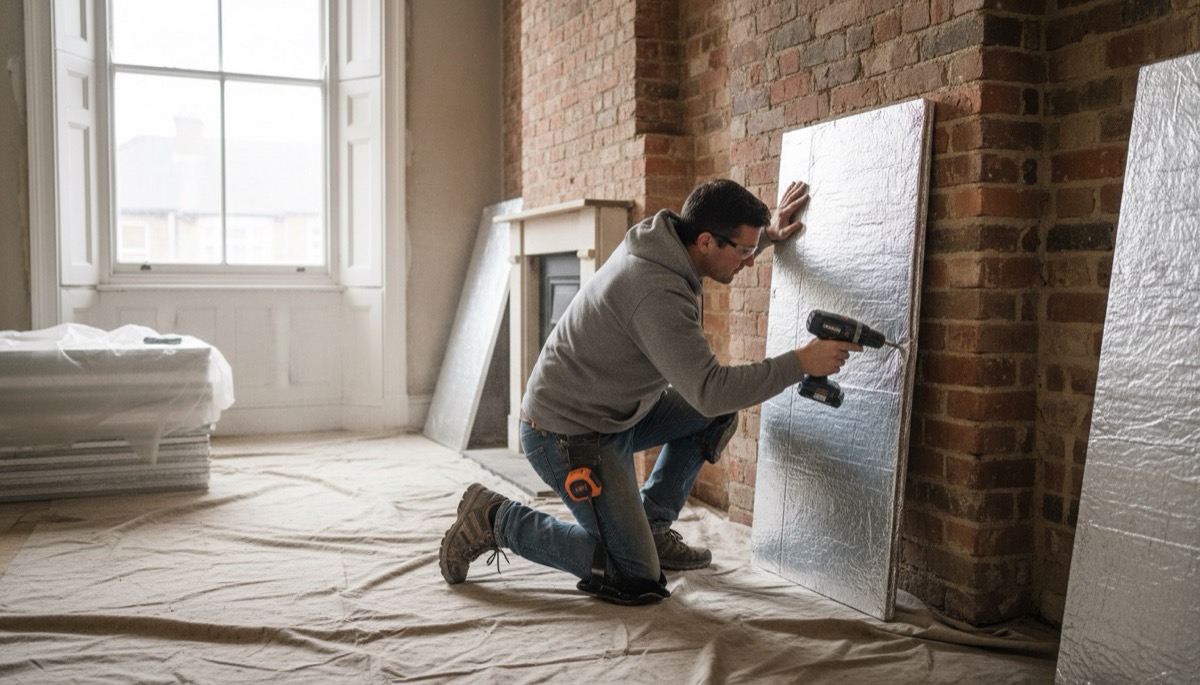
What is a retrofit installer?
A retrofit installer is the person or business that physically fits energy efficiency measures into an existing home. PAS 2030:2023 (clause 3.25) defines the Retrofit Installer as the specialist person or organisation undertaking the physical placement of energy efficiency measures in an existing dwelling. In everyday use, "retrofit installer" also describes the individual operative on site, and that is how this guide uses it.
Retrofit work is not a single trade. Each measure has its own rules, its own qualification pathway and its own annex in PAS 2030:2023. An installer usually specialises in one or two measures, then adds more over time.
| PAS 2030:2023 annex | Measure |
|---|---|
| B.1 | Cavity wall insulation |
| B.2 | Draught proofing |
| B.3 | Energy efficient glazing and doors |
| B.4 | External wall insulation |
| B.5 | Flat roof insulation |
| B.6 | Floor insulation |
| B.8 | Internal wall insulation |
| B.9 | Loft insulation |
| B.10 | Pitched roof insulation |
The standard also covers heating and renewable measures, which generally need MCS certification rather than PAS 2030 for the installing business.
What qualifications does a retrofit installer need?
A retrofit installer needs vocational competence for each measure they install. PAS 2030:2023 (clause 3.27) defines this as holding a regulated, industry-agreed occupational qualification, an apprenticeship, or a personal certificate of competence relevant to the measure. For insulation measures this means an NVQ in Insulation and Building Treatments with the right pathway. The level depends on the measure.
| Measure | Typical qualification | City & Guilds code |
|---|---|---|
| Cavity wall insulation | Level 2 NVQ, Cavity Wall Insulation | 5931-43 |
| Solid floor insulation | Level 2 NVQ, Solid Floor Insulation | 5931-44 |
| Underfloor insulation | Level 2 NVQ, Under Floor Insulation | 5931-45 |
| Cold roof (loft) insulation | Level 2 NVQ, Cold Roof Insulation | 5931-46 |
| Internal wall insulation | Level 3 NVQ, Internal Insulation (Walls) | 5931-58 |
| External wall insulation (boarder) | Level 3 NVQ, EWI – Boarder | 5931-55 |
| External wall insulation (finisher) | Level 3 NVQ, EWI – Finisher | 5931-56 |
| External wall insulation (both) | Level 3 NVQ, EWI – Boarder and Finisher | 5931-57 |
| Room in roof | Level 3 NVQ, Room in Roof | 5931-51 |
The three external wall insulation pathways share the Ofqual accreditation number 603/7689/2 and differ in size: the boarder route is listed at 369 guided learning hours, the finisher at 329, and the combined route at 454.
An NVQ is assessed at work, not in a classroom. An assessor observes you on real installations, questions you, and builds a portfolio of evidence. You therefore need to be working in the trade while you qualify. Our guide to internal wall insulation qualifications explains how this works for one measure in detail.
Can you start retrofit work before you are qualified?
Yes. PAS 2030:2023 recognises two kinds of operative. A specialist operative holds the qualification. A threshold operative is acquiring it, which clause 3.28 defines as taking part in a structured training or assessment programme. Threshold operatives can work on funded jobs under supervision, which is how most installers qualify.
There is a limit on how many unqualified people a team can carry. For both internal and external wall insulation, PAS 2030:2023 sets a competence ratio of no fewer than 1 qualified operative per team of 4 at the site at any time, a ratio of 1 to 3. The standard tells installers to improve on that minimum where the work is complex, geographically spread, or where the supervisor is newly qualified. A qualified operative must also supervise, inspect and sign off the work.
Someone with no training programme in place does not count in that ratio at all. If you want to work on funded retrofit, get enrolled first.
What are the routes into retrofit installation?
There are four realistic routes in, and the right one depends on whether you already work in construction.
- Already in the trade (fastest). Plasterers, dryliners, joiners and general builders can join a retrofit installer as a threshold operative and complete the NVQ on site, usually within a few months. Existing skills transfer directly, but the NVQ also covers moisture risk, thermal bridging and ventilation, which most trades have never been taught.
- Apprenticeship. A construction apprenticeship combines paid work with assessment. PAS 2030:2023 accepts an apprenticeship as evidence of vocational competence in its own right.
- New entrant with no construction background. Start with a short course and a labouring role to build site experience, then move onto an NVQ once you are doing the work regularly. You cannot complete an NVQ without a job that produces the evidence.
- Recognition of Prior Experience and Learning (RPEL). PAS 2030:2023 (clause 3.18) describes RPEL as assessing prior experience and learning against relevant criteria for credit towards a vocational qualification. Experienced installers who never got certificated can use this to shorten the process.
What else do you need besides the NVQ?
Besides the qualification, a retrofit installer needs site access, and the business needs certification. The individual qualification alone does not let you work on funded schemes.
| Requirement | Who needs it | Why |
|---|---|---|
| Measure-specific NVQ, or enrolment on one | Each operative | PAS 2030:2023 competence rules |
| CSCS card | Each operative, for most sites | Site access. A Level 2 NVQ leads to the Blue Skilled Worker card, a Level 3 NVQ to the Gold Skilled Worker card |
| CITB Health, Safety and Environment test | CSCS card applicants | Must be passed within the 2 years before you apply |
| PAS 2030:2023 certification | The employer | Required by funded schemes for insulation measures |
| TrustMark registration | The employer | Required by funded schemes |
| MCS certification | The employer, for low-carbon heating | Covers heat pumps and similar technologies |
| Annual competence check | Each operative | PAS 2030:2023 requires re-verification at no greater than 12-monthly intervals |
The split matters when you are choosing an employer. You can hold every qualification going, but if the business is not PAS 2030 certified and TrustMark registered, it cannot win funded work. The PAS 2030 vs PAS 2035 guide explains how the two standards divide the job between the installer and the retrofit coordinator.
Is there still work in retrofit after ECO4 ends?
Yes, but the source of the work is changing. ECO4 closes on 31 December 2026, and the government has confirmed there will be no successor supplier obligation. Funding moves to government grant schemes under the Warm Homes Plan, which commits £15 billion of public investment to 2030 and aims to upgrade up to 5 million homes.
The Warm Homes Plan states that it should support 180,000 additional jobs in energy efficiency and clean heating by 2030. For installers, the practical change is where the work comes from. Instead of energy suppliers and their managing agents, contracts come through councils and procurement frameworks. The quality requirements are unchanged: the Warm Homes: Local Grant guidance requires PAS 2035:2023, TrustMark registration and PAS 2030 or MCS certification. Our article on what the end of ECO4 means for installers sets out the dates and the checklist.
How long does it take to qualify?
How long it takes depends on how much relevant work you are already doing, because the NVQ is evidence-based rather than time-based. The assessment can only move as fast as you produce real installations to be observed. Someone fitting insulation full time progresses far quicker than someone doing it occasionally.
The published hours give a rough scale. City & Guilds lists the EWI boarder route at 369 guided learning hours and 750 hours total qualification time; the NOCN Level 3 NVQ Diploma in Insulation and Building Treatments is listed on the Ofqual register at 396 guided learning hours and 885 hours total. Total qualification time includes your own practice and evidence-gathering, not just taught hours, so it is a measure of effort rather than a calendar.
Be cautious of any provider promising a Level 3 insulation NVQ in a fixed number of weeks without reference to your workload. The portfolio drives the timescale.
Common mistakes to avoid
- Assuming one qualification covers all measures. Each measure has its own pathway. An internal wall insulation NVQ does not qualify you for external wall insulation.
- Believing the IWI NVQ is Level 2. Many course adverts still say this. The current City & Guilds internal wall insulation pathway (5931-58) sits at Level 3.
- Paying for a course with no job to evidence it. An NVQ needs workplace assessment. Without regular relevant work, you cannot complete it.
- Forgetting the annual check. Your NVQ does not expire, but PAS 2030:2023 requires your employer to re-verify competence at least every 12 months.
- Ignoring the business-level requirements. Qualified operatives at a firm without PAS 2030 and TrustMark still cannot do funded work.
- Treating retrofit as ordinary building work. Moisture, ventilation and thermal bridging are what the qualifications exist to control, and what inspections focus on.
Frequently asked questions
Do I need a qualification to install insulation on private jobs?
No law requires a specific qualification for privately funded insulation work. The Building Regulations still apply in full, covering fire, moisture, ventilation and thermal performance. Qualification requirements come from PAS 2030 certification, TrustMark and the funding schemes.
What is the difference between a retrofit installer and a retrofit coordinator?
A retrofit installer fits the measures and works under PAS 2030. A retrofit coordinator manages the whole project under PAS 2035, including the assessment, design and evaluation, and typically holds a Level 5 Diploma in Retrofit Coordination. They are separate careers with separate qualifications.
Can I get funding for a retrofit NVQ?
Funding varies by nation, age and employment status, and routes change regularly. Check with your employer first, since many retrofit businesses fund the NVQ for operatives they take on, then check current provision through your local college or combined authority.
Which retrofit measure is the best one to start with?
Loft and cavity insulation have the shortest qualification routes and are a common entry point. Internal and external wall insulation sit at Level 3, take longer, and are generally better paid because the work is more technical and the moisture risks are higher.
Do retrofit qualifications work across the whole UK?
Ofqual-regulated qualifications are recognised across the UK, though funding and some scheme rules differ between England, Scotland, Wales and Northern Ireland. PAS 2030:2023 notes that Scotland has its own vocational competence guidance in the Scottish Matrix for Retrofit Skills and Competencies.
How Nexis Academy can help
Nexis Academy is a City & Guilds Approved Centre (T91185) in Manchester, delivering practical internal wall insulation training aligned to PAS 2035 and PAS 2030. More construction and retrofit courses are in development. See our internal wall insulation course or contact our team to talk through the right route for your experience.
If project management appeals more than site work, see what a retrofit coordinator does.
Sources
- BSI, PAS 2030:2023 Installation of energy efficiency measures in existing dwellings — Specification: clauses 3.18, 3.25, 3.27–3.31; Annexes B.1–B.10 (including Tables B.4 and B.8).
- City & Guilds, 5931 Insulation and Building Treatments qualifications.
- Ofqual Register, NOCN Level 3 NVQ Diploma in Insulation and Building Treatments (Construction), 603/7207/2.
- Department for Energy Security and Net Zero, Warm Homes Plan, updated 18 March 2026.
- Department for Energy Security and Net Zero, Warm Homes: Local Grant policy guidance, updated June 2026.
- CSCS, Gold Skilled Worker card and card qualification requirements.