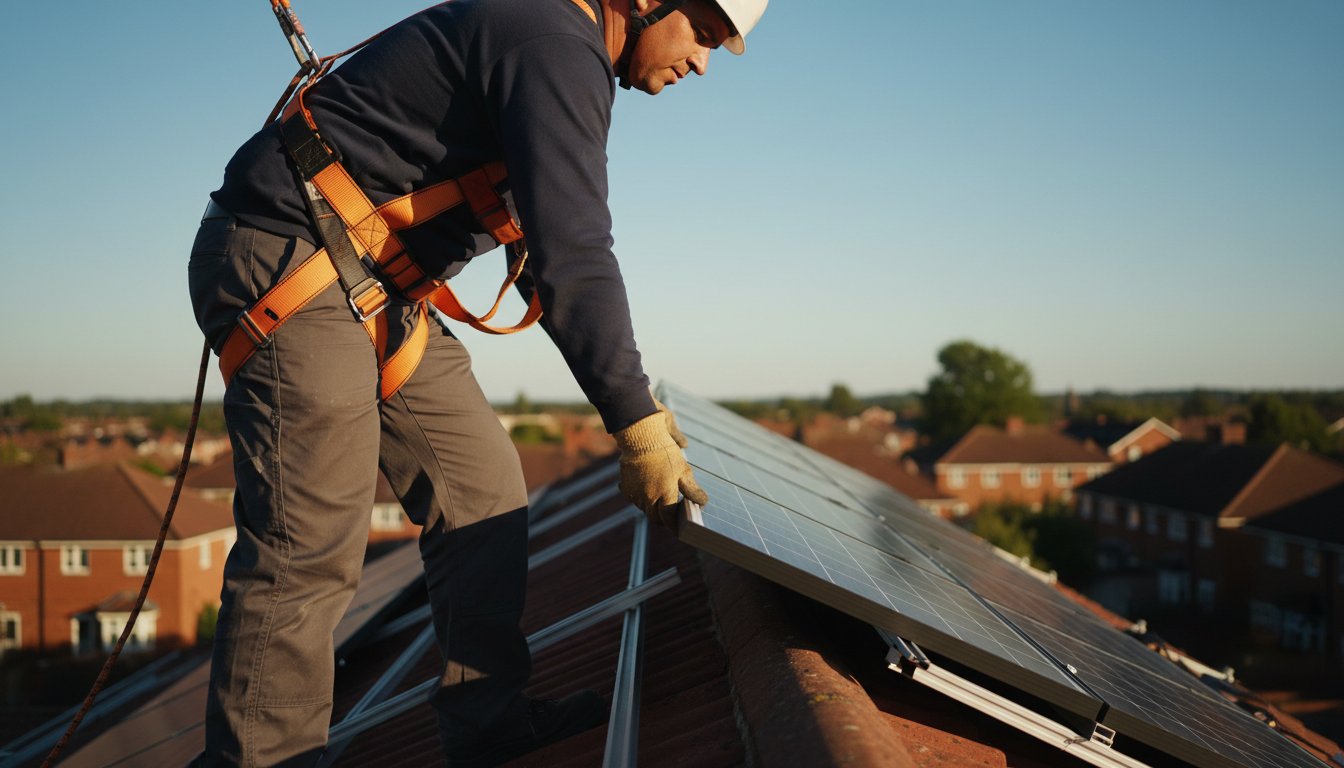
This guide covers the real route: what competency MCS actually requires, how certification works, what it costs, and the grid-connection rules every installer has to know. For the entry-level qualifications themselves, see what qualifications you need to install solar PV. For the certification process in detail, see MCS certification for solar PV installers.
Why MCS matters, even though it's not legally mandatory
Installing solar PV itself isn't a licensed trade — there's no law saying you must hold a particular qualification to fit panels. But MCS certification is, in practice, what makes domestic solar PV work commercially viable, because GOV.UK's own guidance on the Smart Export Guarantee (SEG) — the payment scheme for exporting excess electricity back to the grid — states plainly that "your installation and installer must be certified under the microgeneration certification scheme (MCS), or under an equivalent accredited scheme such as Flexi-Orb." Without MCS (or an equivalent), your customers can't get paid for the electricity they export, which rules you out of most of the domestic market in practice.
The three ways to prove competency
MCS 025, the Competency Standard, sets out exactly how an installer proves they're qualified to be the Nominated Technical Person (NTP) — the person a certified company names as responsible for technical competence. There are three routes, and only one of them involves a named qualification:
| Route | What it involves |
|---|---|
| 1. In-date qualification or personal certification | Evidence of a qualification or certification from the approved list for the technology, gained within the last 5 years |
| 2. MCS-approved non-regulated training | Completion of training that MCS has approved, which doesn't have to be a formal regulated qualification |
| 3. MCS-approved independent competency assessment | An assessment aimed at "experienced individuals who do not hold in date MCS approved training qualifications or personal certifications" |
This third route matters because MCS explicitly retired its older, looser "Experienced Worker Route" and replaced it with this narrower, formal independent assessment. If you've heard that experienced tradespeople can "just prove they know what they're doing" without any formal process, that's out of date — the replacement route still requires a proper MCS-approved assessment, not an informal judgement call.
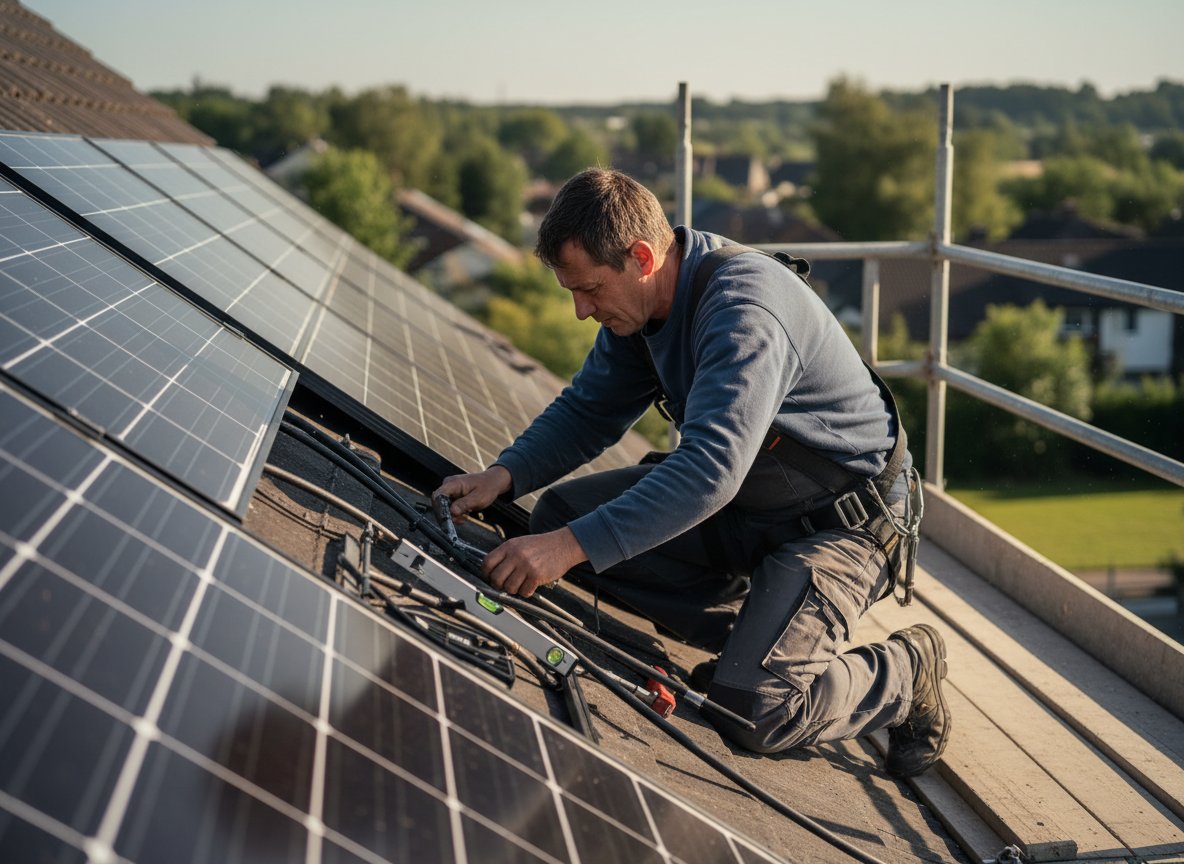
Do you need to be a qualified electrician first?
Not according to MCS's own rules — at least not as a stated requirement. We looked specifically for a clause in MIS 3002 (the Solar PV Installation Standard) or MCS 025 requiring an installer to personally hold a BS 7671 18th Edition wiring regulations qualification or an electrical NVQ Level 3 before training in solar PV, and found none. What MIS 3002 does require is that an MCS-certified company owns a copy of BS 7671 in each office — a documentation requirement, not a personal qualification requirement for every installer.
That said, this is worth being precise about: the absence of a formal MCS prerequisite doesn't mean electrical competence doesn't matter in practice. Solar PV installation is still electrical work, carried out on live domestic supplies, and most training providers and employers treat existing electrical qualifications as the realistic starting point — that's market convention, not an MCS rule. If you're coming from a non-electrical trade background, expect that gap to be the hardest part of your route in, however you formally evidence your competency.
The entry-level qualifications MCS names
For straightforward, non-complex systems, MIS 3002's Appendix A names specific courses that "can help demonstrate competency" — note the standard's own wording is deliberately soft: "a single qualification should not be presumed to prove an individual competent for all situations." The named awards are:
- Level 3 Award in the Installation and Maintenance of Small Scale Solar PV Systems (LCL Awards)
- Level 3 Award in the Installation and Maintenance of Small Scale Solar PV Systems (BPEC)
- Level 3 Award in the Installation of Small Scale Solar PV Systems, 2399-11 (City & Guilds)
- Level 3 Award in the Installation and Maintenance of Small Scale Solar PV Systems, 2399-12 (City & Guilds)
See our full breakdown of these qualifications for what each one actually covers.
Who can certify you
MCS itself doesn't directly certify individual companies — it works through certification bodies who assess companies against the MCS standards. Confirmed certification bodies for solar PV include NAPIT and NICEIC (trading as Certsure). Each certification body sets its own fees and runs its own assessment process on top of the shared MCS requirements, so costs and timelines vary by body — we cover this in detail in our MCS certification guide.
The grid-connection rules you'll need to know
Every solar PV installation connects to the electricity distribution network, and that connection is governed by separate rules from MCS — the Engineering Recommendations G98 and G99:
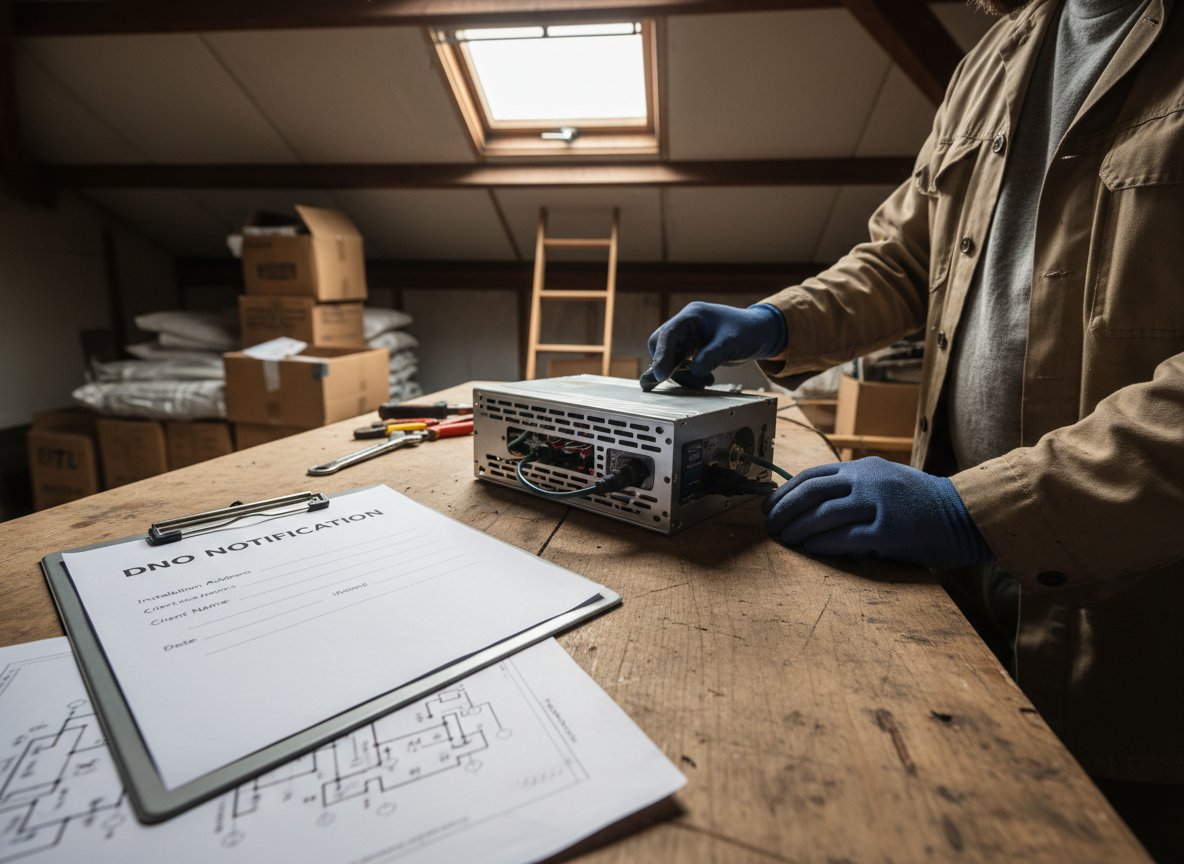
- G98 covers "fully type tested" installations rated under 16A per phase, which is the great majority of domestic solar PV systems. These go in on a "fit and notify" basis: you install first, then notify your Distribution Network Operator (DNO) within 28 days of commissioning. National Grid Electricity Distribution's own guidance adds specific technical conditions: grid interface protection installed and tested, a lockable isolation switch covering all phases, an on-site circuit diagram, and a rule that the installer hasn't commissioned other generation in the same local area within the preceding or following 28 days.
- G99 applies above that threshold, or to more complex connections, and requires a formal application reviewed and accepted by the DNO before the system is energised — not just a post-installation notification.
Getting this wrong has real consequences: failing to notify, or installing a system that should have gone through the more rigorous G99 process as though it were a simple G98 job, puts you in breach of the DNO's connection rules. This sits alongside, not instead of, your MCS technical competence.
A realistic route in
- Build your electrical foundation. Most routes in practice start from an existing electrical background, even though MCS doesn't formally mandate a specific electrical qualification.
- Choose your competency route. Decide whether you'll go for a named entry-level award (fastest to evidence, clearest for newcomers), MCS-approved non-regulated training, or — if you're already experienced — the independent competency assessment route.
- Get your company MCS-ready. Certification is assessed at company level, not just individual competency — you'll need a Technical Supervisor, documented processes, and the required insurance in place.
- Apply to a certification body. NAPIT and NICEIC both certify for solar PV; compare their specific fees and assessment process.
- Learn the DNO notification process. G98/G99 compliance is separate from MCS and just as essential for every installation you do.
- Complete your first assessed installation. Certification bodies require evidence of at least one fully compliant installation as part of the assessment.
Common mistakes
- Assuming one named qualification is "the" solar PV qualification. MCS's own standard explicitly says a single qualification shouldn't be presumed to prove competence for every situation, and offers two other routes besides the named awards.
- Believing experienced tradespeople can skip formal assessment entirely. The old informal "Experienced Worker Route" was retired — there's still a formal MCS-approved independent assessment to complete.
- Treating MCS and G98/G99 as the same thing. MCS is a competency and certification scheme; G98/G99 is a separate DNO grid-connection process. You need both.
- Missing the 28-day G98 notification window. This is a hard deadline from commissioning, not a formality to get round to eventually.
- Assuming BS 7671/18th Edition is a stated MCS prerequisite. It isn't, in the standard's own text — though in practice, most installers come from an electrical background regardless.
Frequently asked questions
Do I need to be a qualified electrician to install solar PV?
Not according to MCS's own rules — there's no stated requirement to hold a BS 7671 18th Edition qualification or electrical NVQ before training in solar PV. In practice, though, most people entering this trade do come from an electrical background, since the work involves live domestic electrical systems.
What's the fastest way to prove competency to MCS?
A named entry-level qualification (like City & Guilds 2399) is the clearest, most straightforward route for newcomers. Experienced tradespeople without one can use MCS-approved non-regulated training or the formal independent competency assessment instead.
Is MCS certification legally required to install solar panels?
No — there's no law requiring it. But without MCS (or an equivalent scheme like Flexi-Orb), your customers can't claim Smart Export Guarantee payments for exported electricity, which makes MCS certification essential in practice for most domestic work.
What's the difference between G98 and G99?
G98 covers simpler installations under 16A per phase, installed on a "fit and notify" basis with a 28-day DNO notification deadline. G99 covers larger or more complex connections and requires a formal application approved by the DNO before the system goes live.
Can I become MCS certified without any formal solar PV qualification?
Yes, if you're an experienced worker — MCS 025 provides a formal independent competency assessment route specifically for people who don't hold in-date MCS-approved training or qualifications.
How Nexis Academy can help
Nexis Academy is a City & Guilds Approved Centre (T91185) in Manchester. We currently deliver internal wall insulation training, with more trade and construction courses in development, including solar PV. We do not yet offer solar PV qualifications, so please register your interest to hear when that changes.
See also what qualifications you need to install solar PV and MCS certification for solar PV installers.
Sources
- MCS, MIS 3002: The Solar PV Installation Standard, v6.0, issued 18 March 2026 — competency requirements (Section 8), entry-level qualifications (Appendix A), BS 7671 document-ownership requirement.
- MCS, MCS 025: The Competency Standard, v2.0, issued 7 September 2022 — the three NTP competency routes, retirement of the Experienced Worker Route.
- MCS, MCS 001-01: The MCS Contractor Standard Part 1, v4.2.
- MCS, "Becoming Certified" and "Redeveloped Installer Scheme".
- GOV.UK, "Smart Export Guarantee".
- National Grid Electricity Distribution, "Micro generation (G98)".