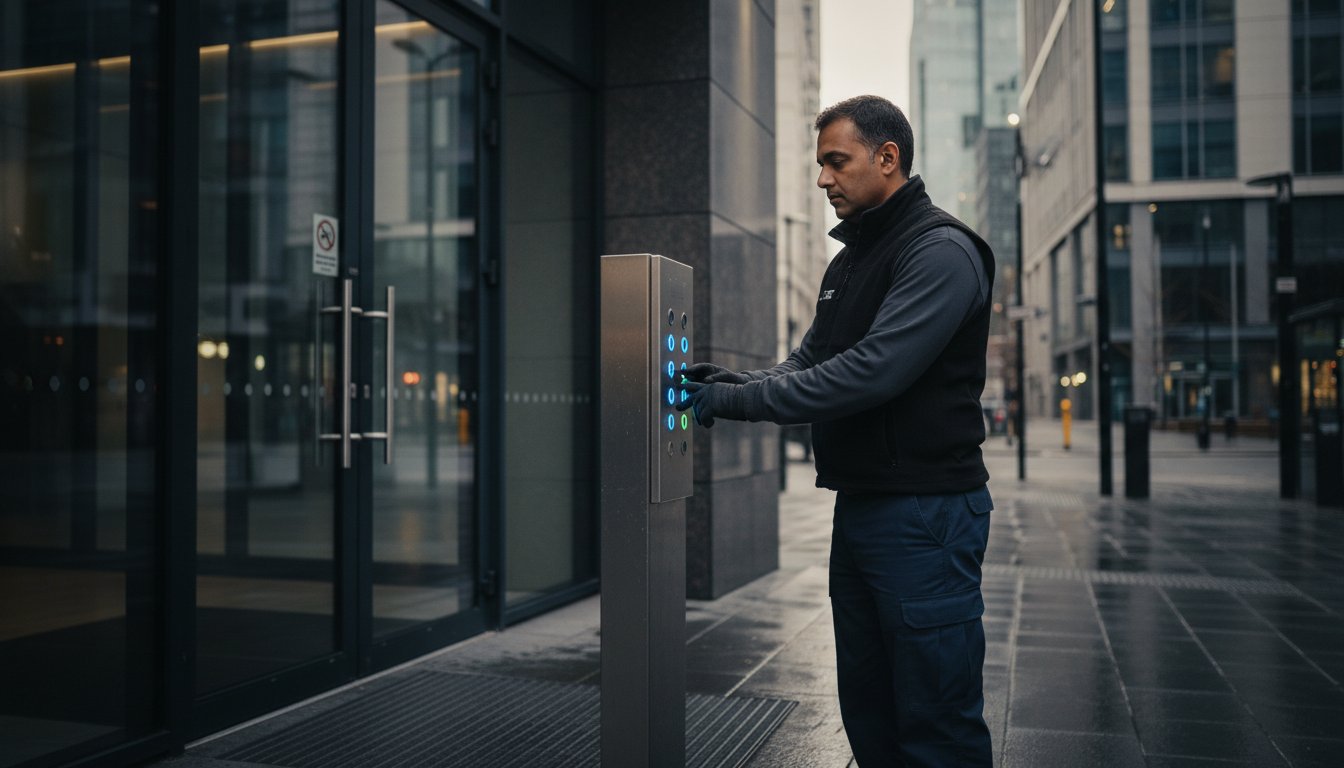
This guide covers the real route: what's actually licensable, the qualification itself, the application process, and what happens if someone works without a licence. For the specific comparison with door supervision, see door supervisor vs security guard. For costs and renewal in detail, see SIA licence cost and how to renew it.
What actually needs a licence
The SIA is clear about what "security guarding" covers as a licensable activity: "You need a security guard licence to guard premises or property against damage, theft, unauthorised access or disorderly behaviour." It includes using CCTV to guard premises against unauthorised access, or property against damage or theft. It does not include using CCTV to watch people in order to guard against disorder or to protect them from assault. That needs a separate public space surveillance (CCTV) licence.
Several roles are explicitly exempt from needing a licence: in-house employees (with specific exceptions — door supervisors at licensed premises always need one), unpaid volunteers, staff checking tickets or invitations without the power to refuse entry, stewards directing people to seats or facilities, and staff responding to sudden emergencies like a fire evacuation. If you're unsure whether a specific role is licensable, check the exemption list directly rather than assuming either way.
The five qualifying requirements
The SIA's own "Get Licensed" booklet sets out exactly what you need to qualify for a front-line licence like Security Guarding:
| Requirement | What it means |
|---|---|
| Age 18 or over | No exceptions for front-line licences |
| Pass an identity check | One "Group A" document plus two "Group B" documents, one showing your current address |
| Pass a criminal record check | Checked against UK records; if you've lived abroad 6+ continuous months in the last 10 years, you need overseas criminal record evidence too |
| Right to work in the UK | Checked by the SIA against Home Office records |
| Hold the required qualification | The Level 2 Award for Working as a Security Officer in the Private Security Industry (or the Scotland equivalent) |
The qualification has to be completed before you apply — it's a precondition of eligibility, not something you can do alongside the application process.

The qualification itself
The current qualification is the Level 2 Award for Working as a Security Officer in the Private Security Industry, built against the SIA's own Knowledge and Skills Specification for Security Guarding. Confirmed from Pearson's regulated BTEC version of this award (other awarding bodies deliver the same SIA-set content, since the guided learning hours are set by the SIA, not the awarding body):
- 38 guided learning hours, split across three mandatory units: Principles of Working in the Private Security Industry (17 GLH), Principles of Working as a Security Officer (10 GLH), and Application of Conflict Management (11 GLH).
- Total Qualification Time: 42 hours.
The SIA's own specification names seven content areas the training covers: roles and responsibilities; access and egress control; electronic and physical protection systems; personal safety (including dynamic risk assessment and the limits of your own authority); drugs awareness; searching; and patrolling, including incident response and crime-scene preservation.
Approved awarding organisations currently include Highfield Qualifications, Laser Learning Awards, NOCN, Pearson, QNUK and SFJ Awards. One live change worth knowing about: BIIAB is being phased out — Ofqual told BIIAB to stop enrolling new learners for security guarding and door supervision from 2 July 2026, and BIIAB-issued qualifications granted after August 2026 won't be accepted. If a provider is still offering BIIAB-badged training, check this against current guidance before enrolling.
A valid first aid qualification — Emergency First Aid at Work or equivalent, with at least 12 months left on it — is required before you can start this training, not just before you apply for the licence.
Checking a training provider is legitimate
The SIA is explicit about where responsibility for provider approval sits: "Training providers are approved by awarding organisations, not by us... The people who train you do not work for us." In practice, that means the right verification step is to ask a provider which awarding organisation approves them (Highfield, Pearson, NOCN, SFJ Awards, QNUK, or Laser Learning Awards), then confirm directly with that awarding organisation that the specific training centre is actually approved — rather than trusting a provider's own claim to be "SIA approved," since the SIA doesn't approve training providers itself.
The application process
- Complete the qualification first. This is a precondition, not a parallel step.
- Create a personal SIA online account and start your application. The first section covers consent to identity and criminal record checks and has to be completed before anything else; the remaining sections can be done in any order, with a final declaration section to close it out.
- Follow the next-steps instructions. UK residents typically visit a Post Office to show identity documents, have a photo taken, and pay the fee. Applicants living abroad typically upload documents and a photo instead.
- Wait for checks, trackable under "my applications" in your online account. The SIA's own "Decision Timescale Indicator" tool gives an estimate based on recent average processing times for applications like yours — explicitly described as an estimate, not a guaranteed timeframe.
- Receive your decision by letter and in your online account.
If your employer is an SIA-approved contractor, they can apply on your behalf — in that case, you link your account to theirs instead of paying and submitting the form yourself.
Criminal record: case-by-case, not a simple exclusion list
Having a criminal record doesn't automatically rule you out. The SIA's own guidance states plainly: "You may still be able to get an SIA licence even if you have criminal offences on your record." Assessment is case-by-case, weighing the offence's relevance to security work, how recent it was, and its severity. There are two automatic refusal grounds, though: being on the sex offenders register, or the SIA judging that you may pose a threat to the public. The SIA publishes a non-exhaustive list of "relevant offence" categories — covering things like violence, dishonesty, drugs and firearms offences — in an annex to its Get Licensed booklet, which is worth checking directly if you have a specific conviction you're unsure about.
What happens if you work without a licence
The Private Security Industry Act 2001 sets real penalties. Engaging in licensable conduct without a licence carries, on summary conviction, up to 6 months' imprisonment or a fine, or both. Supplying unlicensed security operatives is treated more seriously: up to 6 months (summary conviction) or, on conviction on indictment, up to 5 years' imprisonment or an unlimited fine. Company directors can also be prosecuted personally where an offence is committed with their consent, connivance or neglect.
Common mistakes
- Starting the application before finishing the qualification. The Level 2 Award has to be completed first — it's an eligibility precondition, not a parallel process.
- Assuming any criminal record rules you out. Most offences are assessed case-by-case; only two grounds lead to automatic refusal.
- Trusting a provider's own "SIA approved" claim. The SIA doesn't approve training providers — awarding organisations do. Verify directly with the named awarding body.
- Enrolling with a BIIAB-badged course without checking current status. BIIAB is being phased out through 2026; check the qualification will still be accepted before you pay.
- Assuming CCTV monitoring is covered by a Security Guarding licence. It isn't — that needs a separate Public Space Surveillance (CCTV) licence.
Frequently asked questions
What qualification do I need for an SIA Security Guarding licence?
The Level 2 Award for Working as a Security Officer in the Private Security Industry (or the Scotland-specific equivalent), a 38-guided-learning-hour qualification from an SIA-recognised awarding organisation, completed before you apply for the licence.
How much does an SIA licence cost?
£204 per licence, a flat fee regardless of licence type (with one exception for vehicle immobiliser licences). Applying for more than one licence type at once makes each additional licence £102.
Can I get an SIA licence with a criminal record?
Often, yes — most offences are judged case-by-case based on relevance, recency and severity. The only automatic refusals are for being on the sex offenders register or being judged a threat to the public.
Do I need a first aid qualification to train as a security guard?
Yes. A valid Emergency First Aid at Work qualification (or equivalent), with at least 12 months remaining, is required before you can start the Level 2 Award training itself.
What happens if I work as a security guard without a licence?
You can be prosecuted under the Private Security Industry Act 2001, with penalties up to 6 months' imprisonment or a fine on summary conviction for working unlicensed, and up to 5 years' imprisonment for supplying unlicensed operatives.
Does a Security Guarding licence let me work on licensed premises doors?
No. Door work at licensed premises needs a door supervisor licence, which has its own longer qualification. It works the other way round, though: a door supervisor licence also covers security guard work. See our door supervisor vs security guard comparison.
How Nexis Academy can help
Nexis Academy is a City & Guilds Approved Centre (T91185) in Manchester. We currently deliver internal wall insulation training, with more trade and construction courses in development. We do not yet offer SIA-licensed security qualifications, so please register your interest to hear when that changes.
See also door supervisor vs security guard and SIA licence cost and how to renew it.
Sources
- GOV.UK, "Find out if you need an SIA licence".
- GOV.UK, "Apply for an SIA licence".
- GOV.UK, "Check what training you need to get an SIA licence".
- GOV.UK, "Check if you can get an SIA licence with a criminal record".
- SIA, "Get Licensed" criteria booklet, May 2026 edition.
- SIA, Knowledge and Skills Specification: Security Guarding, February 2021.
- Pearson, BTEC Level 2 Award for Security Officers in the Private Security Industry specification, Issue 2, September 2023.
- Private Security Industry Act 2001, sections 3 and 5.