
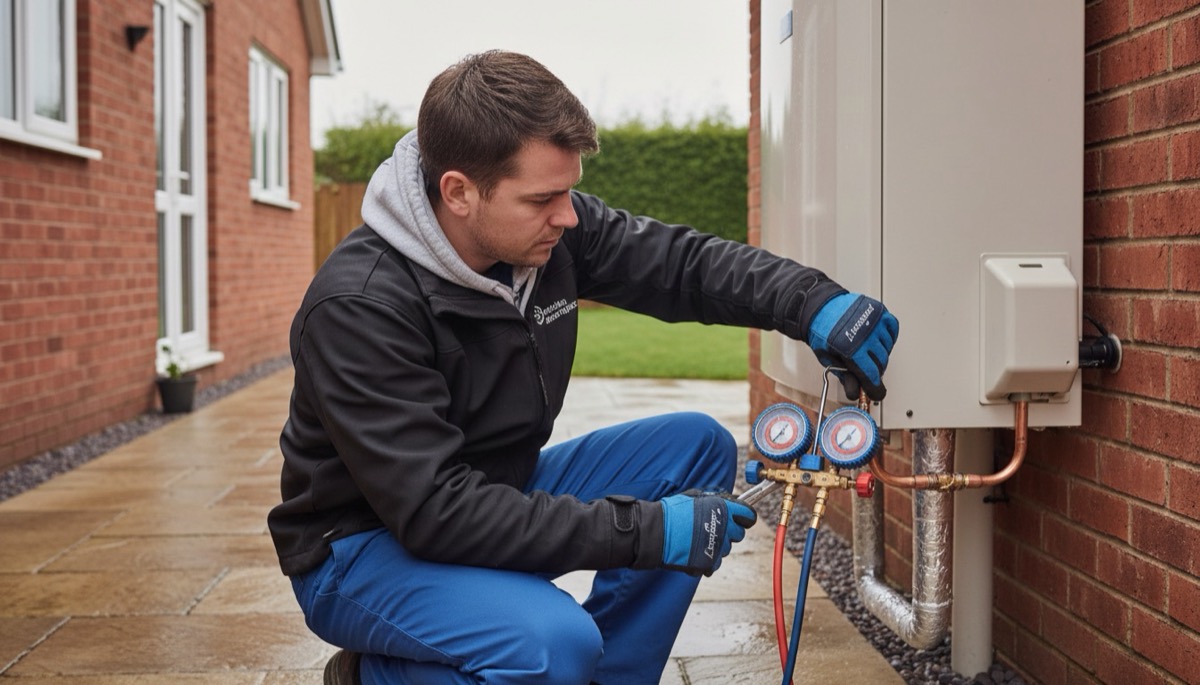
The short version: it depends on monobloc or split
Whether you need F-gas comes down to one question: does the installer work on the refrigerant circuit? Heat pumps come in two forms, and the answer is different for each.
- Monobloc heat pumps keep the entire refrigerant circuit sealed inside the outdoor unit, pre-charged at the factory. The installer connects only the water pipework that carries heat into the house. No refrigerant is handled, so F-gas certification is not required for the installer.
- Split heat pumps divide the refrigerant circuit between the outdoor unit and an indoor unit, with refrigerant pipework joined on site. That refrigerant work is regulated, so the installer does need F-gas certification.
This is why the main heat pump installation qualification is titled for "non-refrigerant circuits": it covers monobloc work, where no refrigerant handling is involved. Understanding this distinction decides what training you need and what systems you can legally install. Our guide to what qualifications you need to install air source heat pumps sets the F-gas question in the context of the whole qualification stack.
What is F-gas and why is it regulated?
F-gas stands for fluorinated greenhouse gases, the refrigerants used in heat pumps, air conditioning and refrigeration. They are powerful greenhouse gases: if released into the atmosphere, many have a global warming potential hundreds or thousands of times that of carbon dioxide. Because of that, handling them is tightly regulated, and only certified people and businesses may work on equipment that contains them.
F-gas certification exists to make sure anyone working on a refrigerant circuit knows how to do it without leaking gas, how to recover it safely, and how to check for leaks. The rules cover installing, servicing, maintaining, repairing and decommissioning equipment containing these gases. For heat pumps, this is exactly the work done when joining the refrigerant pipework of a split system, which is why that work is restricted to certified installers.
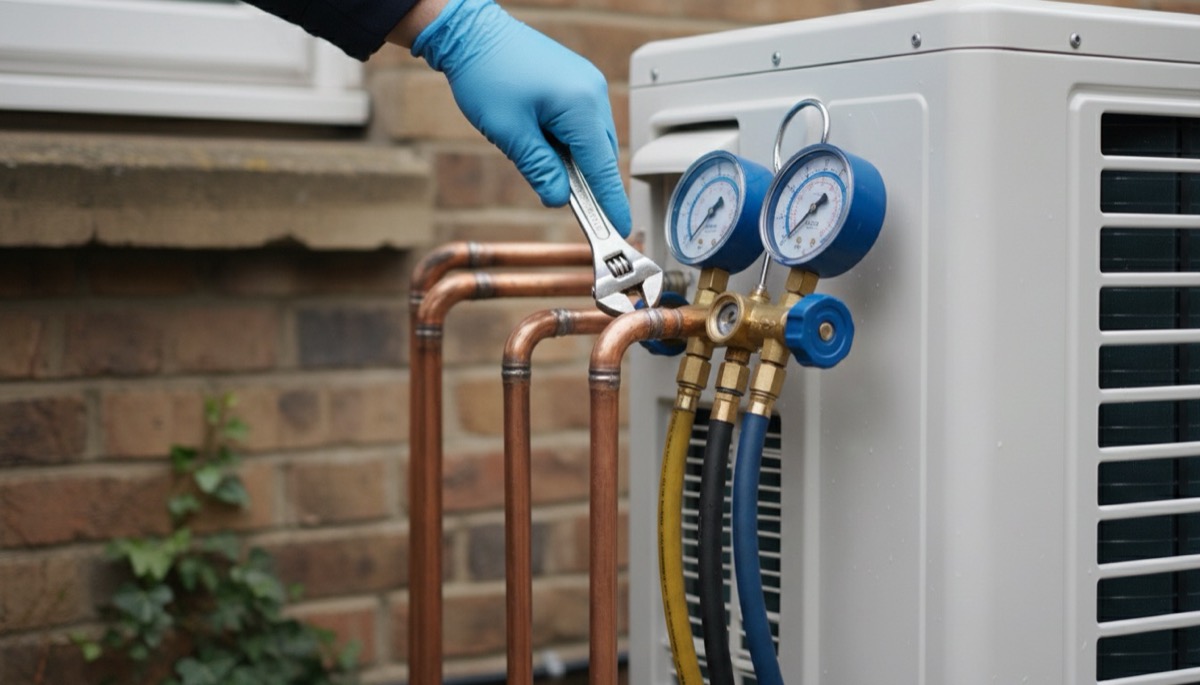
When you do not need F-gas: monobloc systems
Most domestic air source heat pumps installed in the UK are monobloc, and for these the installer does not need F-gas certification. In a monobloc unit, the compressor, refrigerant and all the refrigerant pipework sit inside one sealed outdoor box, charged and tested in the factory. On site, the installer connects water flow and return pipes, not refrigerant pipes. Because no refrigerant is handled, the F-gas rules that govern refrigerant work do not apply to that installer.
This is a deliberate design advantage. Monobloc systems were developed partly to let heating engineers install heat pumps without needing a refrigeration qualification, widening the pool of installers as the country moves off gas. A competent plumber or heating engineer with the heat pump award and the supporting water and unvented tickets can install monobloc systems without ever touching refrigerant.
There is a trade-off. Because the water circuit runs outside to the unit, monobloc systems need frost protection, and they can be slightly less flexible on siting than split systems. But for the great majority of domestic installs, monobloc is the standard choice, and it keeps the installer out of F-gas territory entirely.
When you do need F-gas: split systems
You need F-gas certification to install split heat pumps, because the refrigerant circuit is completed on site. In a split system, the compressor and outdoor components are in the external unit, and a separate indoor unit houses the heat exchanger that transfers heat to the water. The two are joined by refrigerant pipework that the installer must braze, pressure-test, evacuate and charge. All of that is regulated refrigerant work.
To do it legally, the person handling the refrigerant needs an individual F-gas qualification, and the business needs an F-gas company certificate (covered below). The work itself is skilled refrigeration work: making sound brazed joints, evacuating the pipework to remove moisture and air, charging the correct refrigerant to the right amount, and leak-testing the circuit. Done badly, it leaks refrigerant, which is both illegal and harmful, and leaves the heat pump underperforming.
Split systems are more common in air conditioning than in domestic heating, but some heat pump products are split, and they can suit certain installations. If you intend to install them, F-gas certification is not optional.
What refrigerant work on a split system actually involves
The reason split-system work is regulated is that joining a refrigerant circuit well is genuinely skilled, and doing it badly leaks gas. When an engineer installs a split heat pump, the refrigerant work runs through several stages, each of which has to be right. First the copper refrigerant pipework between the indoor and outdoor units is cut, prepared and joined, usually by brazing, which demands clean, sound joints made under a flow of inert gas to stop oxide forming inside the pipe. A poor joint is a future leak.
Next the pipework is pressure-tested, typically with dry nitrogen, to prove it holds before any refrigerant goes in. Then it is evacuated with a vacuum pump to pull out air and, crucially, moisture, because moisture left in a refrigerant circuit causes corrosion and component failure over time. Only once the system holds a deep vacuum is it charged with refrigerant, to the correct weight for the pipe run, and leak-tested again. Every one of these steps is part of what an F-gas qualification teaches and certifies, and every one is a place where an untrained installer can leak gas or leave a system that fails early.
This is the real difference between monobloc and split work. On a monobloc system none of this happens on site; it was all done in the factory and sealed. On a split system the installer carries it out at the property, which is precisely why the regulations require certification for it. It is refrigeration work, not plumbing, and it is treated as such.
What F-gas qualification do you need?
The individual F-gas qualification for this work is commonly City & Guilds 2079, with Category 1 being the full-scope certificate. The F-gas qualifications are split into categories according to the type and size of work:
| Category | Scope |
|---|---|
| Category 1 (C&G 2079-11) | Full scope: install, service, maintain, repair, recover refrigerant and leak-check, with no size limit |
| Category 2 | More limited scope, with restrictions on the size of system and whether refrigerant recovery is included |
| Category 3 | Refrigerant recovery only, from smaller systems |
| Category 4 | Leak checking only, without breaking into the refrigerant circuit |
For heat pump and split-system installation work, Category 1 is the qualification to hold, because it covers the full range of refrigerant handling including installation and recovery with no size limit. The lower categories are narrower and do not cover the full install work. If you are going to install split heat pumps, Category 1 is the practical requirement.
Individual certification vs company certification
F-gas has two layers: the individual and the business, and for commercial refrigerant work you need both. The individual engineer holds the personal F-gas qualification, such as City & Guilds 2079 Category 1. Separately, a business that carries out refrigerant work on another person's equipment needs an F-gas company certificate, issued by an F-gas certification body. The company certificate confirms the business has enough qualified staff, the right equipment and the right procedures to handle refrigerant properly.
This catches people out. Holding the personal 2079 qualification is necessary but not sufficient to run a business installing split systems; the company also has to be certified. It is the same split you see in MCS, where the business is certified and the individual holds the competence. If you only ever install monobloc heat pumps, neither the individual F-gas qualification nor the company certificate applies to you.
How F-gas fits with MCS and the rest of the heat pump stack
F-gas sits alongside, not instead of, your MCS certification and heating qualifications. A heat pump business needs several things that each cover a different part of the job, and F-gas is only the refrigerant piece. The full picture for a typical installer looks like this:
| Element | Covers | Needed for |
|---|---|---|
| Heat pump award (non-refrigerant circuits) | Installing and commissioning the heat pump (water side) | All heat pump work |
| Water Regulations and unvented (G3) | Connection to the water system and hot water storage | All heat pump work |
| MCS certification (business) | Design, install, commission and handover to standard | Grant-funded work |
| Electrician | The electrical connection | Every installation |
| F-gas (individual 2079 + company certificate) | Refrigerant circuit work | Split systems only |
So a business that installs only monobloc systems needs the heat pump, water, unvented and MCS pieces, plus an electrician, but no F-gas. A business that also installs split systems adds the F-gas qualifications on top. Our guides to how to become a heat pump installer and MCS certification for heat pump installers cover the other pieces.
Which refrigerants do heat pumps use?
Modern heat pumps increasingly use lower-GWP refrigerants, and the one in the system affects how it must be handled. Older systems often used refrigerants with a high global warming potential, but the trend is firmly towards lower-GWP gases. Two you will see often are R32, widely used in many current heat pumps, and R290, which is propane, used in a growing number of models because its global warming potential is very low.
These newer refrigerants bring a safety dimension as well as an environmental one. Some are mildly flammable and some, like propane, are more flammable, which affects siting, pipework and handling. Where refrigerant is handled on site, as in split installs, the engineer's F-gas competence and the manufacturer's instructions govern how it is done safely. For monobloc systems, the refrigerant stays sealed in the factory-charged unit, so the installer does not handle it regardless of type, though siting rules for flammable refrigerants still matter.
Is F-gas a legal requirement?
Yes, where refrigerant is handled. Working on a refrigerant circuit without the required F-gas certification is not merely a scheme rule; it is a breach of the regulations that govern fluorinated gases, and it carries the risk of enforcement action. The rules exist because leaked refrigerant is environmentally damaging and, with flammable gases, potentially dangerous.
The practical consequence for a heat pump business is simple. If you install split systems, you and your business must be properly F-gas certified before you touch the refrigerant pipework. If you install only monobloc systems, the refrigerant stays sealed and the requirement does not apply to you. There is no grey area in between: the trigger is whether the installer works on the refrigerant circuit.
F-gas rules are tightening over time
The direction of travel in F-gas regulation is away from high-global-warming-potential refrigerants, and that shapes the equipment coming to market. The rules place a shrinking cap on the amount of high-GWP refrigerant that can be sold, which pushes manufacturers towards lower-GWP gases such as R32 and, increasingly, natural refrigerants like R290 (propane). For installers, this matters in two ways.
First, the systems you install will increasingly use these newer refrigerants, which can be mildly or more flammable, bringing siting and handling rules that did not apply to older gases. Second, the long-term pressure on high-GWP refrigerants is one more reason the industry favours monobloc designs, where a small, sealed, factory-charged quantity of refrigerant stays inside the unit and is never handled on site. A monobloc using a natural refrigerant keeps both the environmental impact and the on-site handling to a minimum.
None of this changes the basic rule for installers: if you handle refrigerant, you need F-gas certification, and if you do not, you do not. But it does mean the F-gas landscape is not static, and it is worth keeping an eye on how refrigerant rules and products evolve if split-system work is part of your plan.
How to decide which systems to offer
For most installers moving into heat pumps, the straightforward route is to start with monobloc systems and add F-gas later only if split work justifies it. Monobloc covers the large majority of domestic heating installations, keeps you out of refrigerant regulation, and lets you get into the market with the heat pump award and supporting tickets. You can build a complete, grant-funded heat pump business installing monobloc systems alone.
Adding split-system capability means taking on the F-gas qualification and company certificate, and the extra skills of refrigeration work. It makes sense if you have demand for split products, perhaps from air conditioning crossover work, or specific installations where a split system is the better fit. For a pure domestic heating installer, monobloc-only is often the pragmatic choice; for a business that also does air conditioning, F-gas may already be in hand. Decide based on the work you actually expect, not on wanting to tick every box.
Frequently asked questions
Do monobloc heat pumps need F-gas certification?
No. Monobloc heat pumps have a sealed, factory-charged refrigerant circuit inside the outdoor unit, and the installer connects only the water side. Because no refrigerant is handled on site, F-gas certification is not required for installing monobloc systems.
Do split heat pumps need F-gas certification?
Yes. Split heat pumps have refrigerant pipework that is joined and charged on site, which is regulated work. The installer needs an individual F-gas qualification such as City & Guilds 2079 Category 1, and the business needs an F-gas company certificate.
What is City & Guilds 2079?
City & Guilds 2079 is the F-gas qualification for handling fluorinated refrigerant gases. Category 1 (2079-11) is the full-scope version, covering installation, service, maintenance, refrigerant recovery and leak checking with no size limit, which is what split heat pump work requires.
Can I install heat pumps without any F-gas qualification?
Yes, if you install only monobloc systems. A plumber or heating engineer with the heat pump award and the supporting water and unvented qualifications can install monobloc heat pumps without F-gas. You only need F-gas if you install split systems.
Is F-gas the same as MCS?
No. They cover different things. MCS certifies your heat pump installation competence and is needed for grant-funded work. F-gas governs refrigerant handling and is needed only for split systems. A monobloc installer needs MCS but not F-gas.
Does my whole company need F-gas or just me?
Both, for split work. The individual engineer holds the personal F-gas qualification, and the business that carries out refrigerant work needs a separate F-gas company certificate. Holding the personal qualification alone does not let the business legally handle refrigerant commercially.
Which refrigerants should I expect in modern heat pumps?
Increasingly lower-GWP refrigerants such as R32 and R290 (propane). These reduce environmental impact but can be flammable, which affects siting and handling. In monobloc systems the refrigerant stays sealed in the factory-charged unit, so the installer does not handle it.
How Nexis Academy can help
Nexis Academy is a City & Guilds Approved Centre (T91185) in Manchester. We currently deliver internal wall insulation training, with heat pump and other retrofit courses in development. Register your interest and we will let you know when heat pump training is available. See also what qualifications you need to install air source heat pumps and how to become a heat pump installer.
Sources
- City & Guilds, 2079 F-Gas and ODS Regulations qualifications: category scopes including Category 1 full scope.
- MCS, Heat Pump Installation Standard MIS 3005-I:2025: monobloc and split system definitions.