
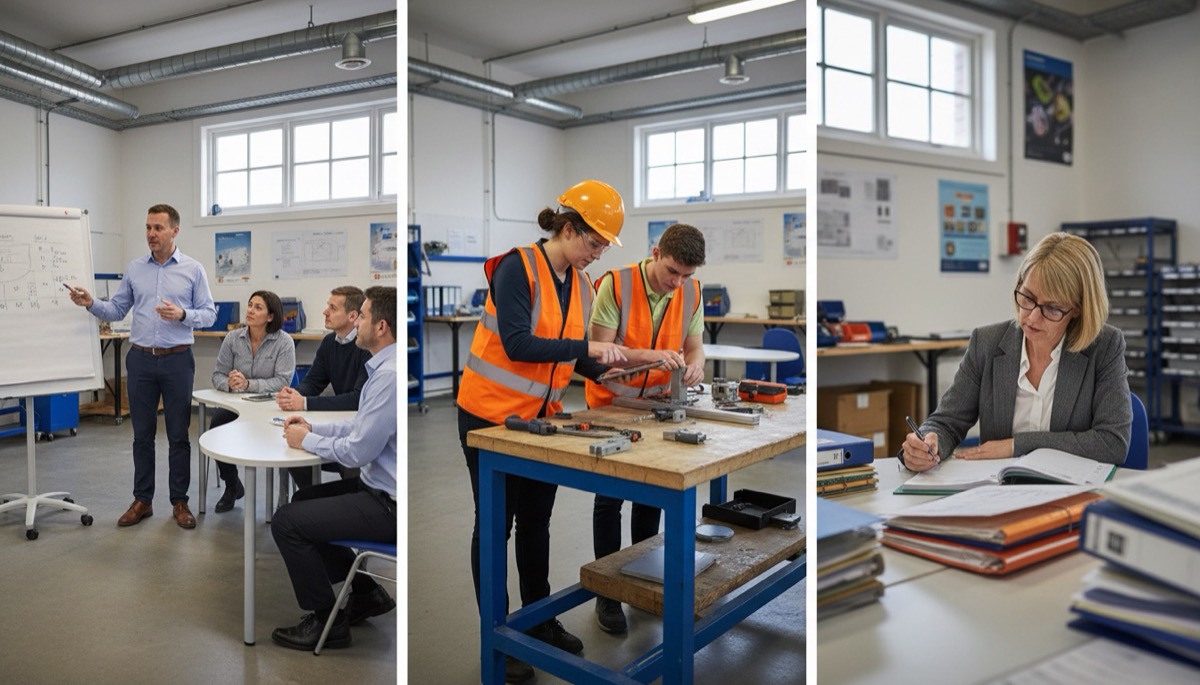
Tutor vs assessor vs IQA at a glance
The three roles sit in a chain: the tutor teaches the learner, the assessor judges the learner, and the IQA checks the assessor. They need different qualifications and suit different temperaments.
| Tutor | Assessor | IQA | |
|---|---|---|---|
| Main job | Delivers teaching and training | Judges learners against a standard | Checks and standardises assessors |
| Works with | Learners, in a group | Learners, one to one | Assessors |
| Entry qualification | Level 3 Award in Education and Training (AET) | Level 3 Certificate in Assessing Vocational Achievement (CAVA) | Level 4 Award in the Internal Quality Assurance of Assessment (6317-41) |
| Full qualification | Level 5 Diploma in Teaching (FE and Skills) | CAVA is the full assessor certificate | Level 4 Certificate in Leading IQA (6317-42) |
| Needs trade competence | Yes | Yes | Yes |
| Suits people who like | Explaining, planning lessons, group delivery | Observing, questioning, evidencing | Checking, standardising, feedback |
| Typical seniority | Entry to mid | Entry to mid | Senior |
All three require occupational competence in your trade, usually a Level 3 NVQ plus experience. The teaching or assessing qualification sits on top of that.
What does a tutor do?
A tutor plans and delivers learning to a group, teaching people the knowledge and skills of a trade. The job is about explaining clearly, running sessions, keeping learners engaged and checking they understand. It is the most "front of room" of the three roles.
Tutoring suits people who enjoy delivery and communication. If you are the person on site others come to for an explanation, and you like breaking a skill down so someone else can do it, teaching plays to that.
The qualification route starts with the Level 3 Award in Education and Training (AET), an entry teaching qualification that can be done through a micro-teach without being employed as a tutor. From there you build to the Level 5 Diploma in Teaching (Further Education and Skills), the full teaching qualification, usually while working. Our guide on how to become a trade tutor covers the full path, including QTLS.
What does an assessor do?
An assessor decides whether a learner has met the required standard, by observing them work, questioning them, and gathering evidence into a portfolio. The assessor is the person who signs off that a learner is competent, so the role is about judgement and evidence rather than delivery.
Assessing suits people who are observant, thorough and good at drawing out what someone knows. Much of the work is one to one: watching an installer on site, holding a professional discussion, reviewing a portfolio. For trades with on-site NVQs, like insulation and retrofit, assessors travel to assess competence in real workplaces.
The qualification is the CAVA, the Level 3 Certificate in Assessing Vocational Achievement, which covers both workplace assessment and assessment of skills, knowledge and understanding. You need access to real learners to complete it.
What does an IQA do?
An internal quality assurer checks the assessors, making sure their decisions are fair, valid and consistent across the whole centre. The IQA samples assessment decisions, runs standardisation meetings, supports assessors, and prepares for the awarding organisation's external quality assurance visits. It is a step back from the learner and a step up in responsibility.
IQA suits experienced, methodical people who are comfortable with records, standards and giving other professionals feedback. You generally become an IQA after working as an assessor, because you need to understand assessment from the inside before you can assure it.
The qualification is a Level 4 internal quality assurance award, most commonly the Level 4 Award in the Internal Quality Assurance of Assessment (6317-41), or the Certificate in Leading IQA (6317-42) if you will run the function. Our guide to what an IQA does explains sampling, standardisation and the route in.
Which path should you choose?
Choose the role that matches what you enjoy and how senior a position you want, not just the pay. Here is a simple way to decide.
- Choose tutoring if you like being at the front of a room, explaining and delivering, and you want to teach groups. Start with the AET.
- Choose assessing if you prefer one-to-one work, observing people do the job, and evidencing competence. Start with the CAVA.
- Choose IQA if you already assess, want a more senior quality role, and are comfortable with compliance and standards. Move up to a Level 4 IQA qualification.
You do not have to pick one forever. A very common progression from a trade is:
- AET and start tutoring, or CAVA and start assessing.
- Add the other once you are established, so you can both teach and assess.
- Move into IQA once you have assessing experience, for a senior role.
How the qualifications fit together
The teaching and assessing qualifications are separate ladders that many people climb in parallel. Teaching qualifications run AET to Diploma in Teaching. Assessing and quality assurance run CAVA to Level 4 IQA. Both sit on top of your trade competence.
| Area | Entry | Next step |
|---|---|---|
| Teaching | Level 3 Award in Education and Training (AET) | Level 4 CET, then Level 5 Diploma in Teaching |
| Assessing | Level 3 CAVA | — (CAVA is the full assessor certificate) |
| Quality assurance | Level 4 Award in IQA (6317-41) | Level 4 Certificate in Leading IQA (6317-42) |
Holding more than one makes you more employable and more useful to a centre. A trainer who can teach, assess and quality-assure can cover far more of a centre's delivery than someone who only teaches.
Which pays the most?
Pay depends on the subject, employer and region more than on the role itself, and reliable published figures for trade-training roles are hard to pin down, so treat any single number with caution. As a general pattern, IQA roles tend to sit above assessor and tutor roles because they are more senior and carry compliance responsibility, and freelance assessors in high-demand trades can earn well per assessment. Rather than chase a headline salary, look at live job adverts in your own trade and region for a realistic picture.
Frequently asked questions
Can I be a tutor, assessor and IQA at the same time?
Yes, if you hold the qualifications for each and manage any conflicts of interest. The one rule is that an IQA cannot quality-assure their own assessment decisions, because that removes the independent check. Many trade trainers teach, assess and quality-assure across different cohorts.
Which should I do first, the AET or the CAVA?
Start with whichever matches the job you can get. If you will be delivering training, do the AET first. If you will be assessing learners, do the CAVA first. They are independent qualifications, so neither is a prerequisite for the other.
Do I need a degree for any of these roles?
No. None of these roles requires a degree. The Department for Education calls the idea that you need one "one of the biggest myths about the sector." Your Level 3 trade qualification and industry experience are the foundation, and QTLS, the fully qualified teacher status, does not require a degree either.
Do I need to be working to get these qualifications?
The AET can be completed through a micro-teach without a teaching job. The CAVA and the Level 4 IQA qualifications have practical units that require real learners or assessors, so you need access to them, through a job or a placement, to finish.
Which role has the most demand?
All three are in demand wherever regulated vocational qualifications are delivered, and that is growing. The Warm Homes Plan alone states it should support 180,000 additional jobs in energy efficiency and clean heating by 2030, and training those workers needs tutors, assessors and IQAs across construction and retrofit.
How Nexis Academy can help
Nexis Academy is a City & Guilds Approved Centre (T91185) in Manchester. Teaching, assessing and quality assurance courses are in development as part of our growing portfolio, so contact our team to register your interest.
We are also recruiting tutors, assessors and IQAs for our own delivery team. See careers at Nexis Academy to apply.
See also how to become an IQA and quality nominee vs IQA.
Sources
- City & Guilds, Level 3 Award in Education and Training (6502) Qualification Handbook v1.6.
- City & Guilds, Level 3 and 4 Awards and Certificates in Assessment and Quality Assurance (6317) Handbook v1.8.
- Department for Education, Teach in Further Education: FAQs; Education and Training Foundation, QTLS eligibility.