
What does the CAVA cover?
The CAVA covers both halves of the assessor's job: understanding the theory of assessment, and proving you can assess people in practice, both on the job and off it. To achieve the City & Guilds Level 3 Certificate in Assessing Vocational Achievement (6317-33), learners must achieve 15 credits from three units.
| Unit | Title | Credits | Guided learning hours |
|---|---|---|---|
| 301/205 | Understanding the Principles and Practices of Assessment | 3 | 24 |
| 302 | Assess Occupational Competence in the Work Environment | 6 | 30 |
| 303 | Assess Vocational Skills, Knowledge and Understanding | 6 | 30 |
Unit 301 is knowledge-only and is assessed by written work. Units 302 and 303 are performance units: you have to assess real learners and be observed doing it.
The two practical units cover different settings, which is why the full certificate is more useful than either award on its own:
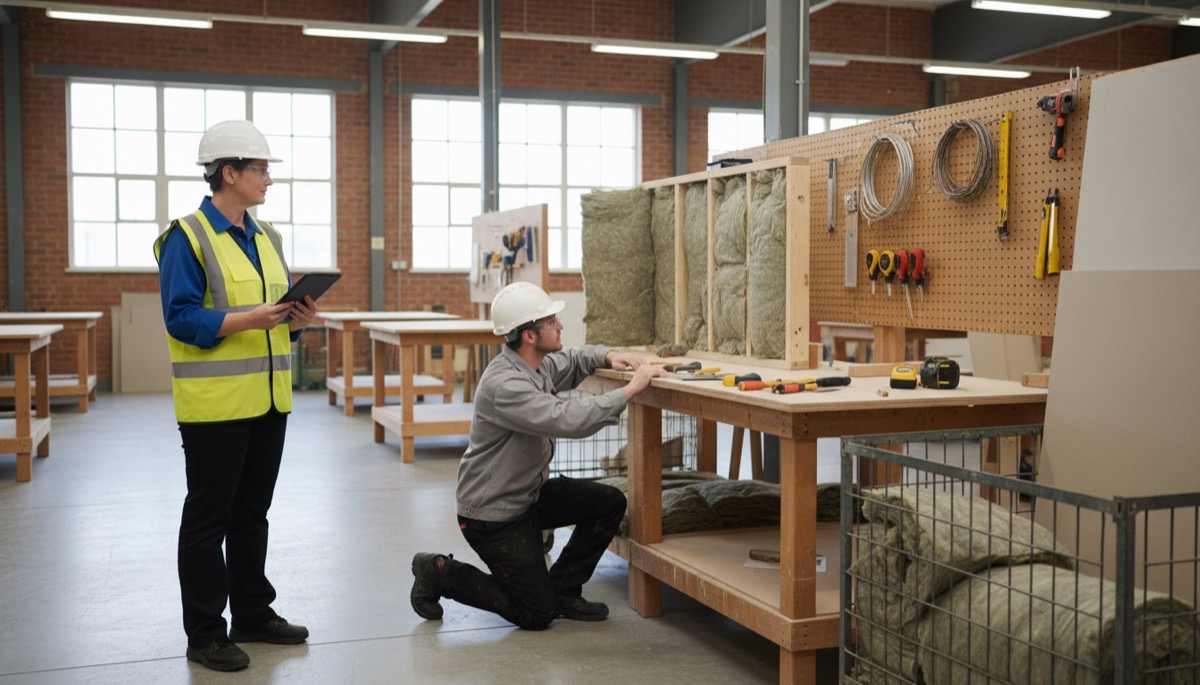
- Unit 302 is assessment in the workplace, such as observing an installer fitting insulation on site.
- Unit 303 is assessment away from the workplace, such as marking assignments, running professional discussions, or assessing a practical task in a training centre workshop.
What are the key facts and numbers?
| Detail | City & Guilds Level 3 Certificate in Assessing Vocational Achievement |
|---|---|
| City & Guilds qualification number | 6317-33 |
| Regulatory reference number | 501/1679/4 |
| Level | 3 |
| Credits | 15 |
| Guided learning hours | 84 |
| Total qualification time | 150 hours |
| Age group approved | 18+ |
| Entry requirements | None |
Total qualification time is the realistic measure of effort: 150 hours including your own portfolio building, not just the 84 taught hours.
CAVA vs the two smaller assessor awards
The CAVA is the largest of three Level 3 assessor qualifications in the same City & Guilds suite. The smaller awards suit people who only assess in one setting; the CAVA covers both.
| Qualification | C&G number | Ofqual reference | Units | GLH | TQT |
|---|---|---|---|---|---|
| Level 3 Award in Understanding the Principles and Practices of Assessment | 6317-30 | 501/1648/4 | 301/205 only | 24 | 30 |
| Level 3 Award in Assessing Competence in the Work Environment | 6317-31 | 501/1676/9 | 301/205 + 302 | 54 | 90 |
| Level 3 Award in Assessing Vocationally Related Achievement | 6317-32 | 501/1677/0 | 301/205 + 303 | 54 | 90 |
| Level 3 Certificate in Assessing Vocational Achievement (CAVA) | 6317-33 | 501/1679/4 | 301/205 + 302 + 303 | 84 | 150 |
Which to choose:
- 6317-30 is knowledge-only. It does not qualify you to assess anyone. It suits managers and quality staff who need to understand assessment without doing it.
- 6317-31 suits workplace-only assessors, such as someone who only ever observes competence on site.
- 6317-32 suits classroom or centre-only assessors.
- The CAVA (6317-33) covers both practical settings and is what most employers and awarding organisations ask for, because it leaves nothing out.
What is the difference between CAVA and TAQA?
TAQA is the informal umbrella name for this whole family of assessment and quality assurance qualifications; CAVA is one specific qualification within it. TAQA stands for Training, Assessment and Quality Assurance, and job adverts often use it loosely to mean "an assessor qualification", which causes confusion.
The City & Guilds 6317 suite that contains the CAVA also contains the Level 4 internal quality assurance qualifications:
| Qualification | C&G number | Ofqual reference | GLH | TQT |
|---|---|---|---|---|
| Level 4 Award in Understanding the Internal Quality Assurance of Assessment Processes and Practice | 6317-40 | 501/1649/6 | 45 | 60 |
| Level 4 Award in the Internal Quality Assurance of Assessment Processes and Practice | 6317-41 | 501/1678/2 | 90 | 120 |
| Level 4 Certificate in Leading the Internal Quality Assurance of Assessment Processes and Practice | 6317-42 | 501/1680/0 | 115 | 170 |
If a job advert asks for "TAQA Level 3", it almost always means the CAVA. If it asks for "TAQA Level 4", it means one of the internal quality assurance qualifications above. When applying, name the exact qualification you hold rather than the umbrella term.
Do you need to be working to complete the CAVA?
Yes, in practice. Units 302 and 303 require you to assess real learners and be observed doing so, which means you need access to candidates. The qualification itself has no formal entry requirements and no prior qualification is needed, but the portfolio cannot be built without people to assess.
Two routes work:
- You already assess informally. Supervisors, trainers and experienced tradespeople who sign off others' work can usually generate the evidence in their existing role.
- A provider or employer gives you access to learners. Some training providers arrange placement candidates for CAVA learners. Confirm this before enrolling if you are not currently in a role that provides them.
You also need to be occupationally competent in what you assess. The qualification teaches you how to assess, not the subject itself, so awarding organisations expect assessors to be qualified and experienced in the trade they assess. For retrofit and insulation, that typically means holding the relevant NVQ, as covered in our guide to internal wall insulation qualifications.
Do you need the CAVA to work as an assessor?
You need an approved assessor qualification to assess regulated vocational qualifications, and the CAVA is the current standard one. The requirement comes from awarding organisations and centre approval conditions rather than from law. Each awarding organisation sets what it will accept for its own qualifications, so check with the specific one before committing.
Older assessor qualifications are often still recognised:
| Old qualification | Status |
|---|---|
| A1 / A2 | Legacy. Widely still accepted, but check with the awarding organisation |
| D32 / D33 | Older legacy units. Acceptance varies, and evidence of current practice is often required |
| TAQA Level 3 awards and certificate | Current; the CAVA is the full certificate in this suite |
If you hold A1 or D32/D33, do not assume they are dead. Many centres accept them alongside evidence of continuing professional development. Equally, do not assume they are enough: ask the awarding organisation in writing.
Is the CAVA the same as a teaching qualification?
No. The CAVA qualifies you to assess, not to teach. Teaching is covered by the Level 3 Award in Education and Training (AET), which deals with planning and delivering learning. The CAVA deals with judging whether a learner has met a standard, and evidencing that judgement.
Many people in vocational training hold both, because the jobs overlap. A typical progression from a trade is:
- AET to learn how to teach your subject.
- CAVA to assess learners against the standard.
- Level 4 internal quality assurance to sample and standardise other assessors' decisions.
Frequently asked questions
How long does the CAVA take?
The qualification is 84 guided learning hours and 150 hours total qualification time. Calendar time depends on how quickly you can gather assessment evidence with real learners, which is usually the limiting factor rather than the taught content. Most providers quote a few months part time.
Can I do the CAVA online?
The knowledge unit (301/205) is commonly delivered online. Units 302 and 303 require you to be observed assessing real learners, so there is always a practical component, however the theory is delivered.
Does the CAVA expire?
No. The CAVA does not expire. Awarding organisations and employers normally expect assessors to show continuing professional development and current occupational competence in the subject they assess.
What is the difference between CAVA and the Level 3 Award in Assessing Competence in the Work Environment?
The award (6317-31) covers only workplace assessment: units 301/205 and 302, at 54 guided learning hours. The CAVA (6317-33) adds unit 303 for assessing vocational skills, knowledge and understanding away from the workplace, taking it to 84 guided learning hours. The CAVA lets you assess in both settings.
Can I do the CAVA before I have an NVQ in my trade?
The CAVA has no entry requirements, so you can technically take it first. However, awarding organisations expect assessors to be occupationally competent in what they assess, so without a relevant trade qualification and experience you may hold the CAVA and still not be approved to assess.
How Nexis Academy can help
Nexis Academy is a City & Guilds Approved Centre (T91185) in Manchester. Assessing and quality assurance courses are in development as part of our growing portfolio. Contact our team to register your interest.
We are also recruiting qualified assessors and internal quality assurers for our own delivery team. See careers at Nexis Academy.
See also how to become a vocational assessor, CAVA vs the Level 3 Award in Assessing Competence, what an IQA does and tutor, assessor or IQA?.
See also Assessing Competence in the Work Environment vs Assessing Vocationally Related Achievement.
Sources
- City & Guilds, Level 3 and 4 Awards and Certificates in Assessment and Quality Assurance (6317-30-33, 40-42) Qualification Handbook v1.8, November 2025: qualification summary (age group, entry requirements), qualification table (GLH, TQT, regulatory reference numbers) and structure.