

The good news is that being older is rarely the obstacle. Adults tend to turn up on time, talk to customers well and understand what a job costs. The real obstacles are income while you train, and getting access to real jobs. This guide walks through each route honestly, including what it costs you in time and money.
Is it too late to become a plumber?
No. There is no upper age limit on any route, whether you are 25 or 55. City & Guilds approves its 6189 NVQ Diplomas for candidates aged 16 and over, with no maximum. Apprenticeships are also open to adults, and if you can find an employer, an adult apprenticeship remains a good option. This guide is for people who cannot or do not want to take that route.
What changes with age is your starting position. You may have a mortgage, a family and a job you cannot walk out of. You may also have skills that transfer. Time on building sites, in maintenance, in the forces or in a related trade can all help, and may count towards the experienced worker route if it was genuine plumbing work.
Be honest about the physical side too. Plumbing involves lifting, kneeling, working in tight spaces and sometimes in the cold. Many plumbers work well into later life, but go in with your eyes open.
The three routes that work for adults
| Route | Who it suits | What you need | Main risk |
|---|---|---|---|
| Plumber's mate, then NVQ | People who can accept a lower wage while they learn | An employer willing to register you | Years of work with no qualification, if the employer will not support you |
| College diploma, then NVQ | People who want a base of skills before they approach employers | Time and money for the course, then an employer | Finishing the diploma with no route to on-site work |
| Experienced worker | People already working in plumbing | At least 3 years' proven work | Evidence that does not stand up |
All three lead to the same place: an NVQ Diploma, then a JIB-PMES card. For how the two levels compare, see Level 2 vs Level 3 plumbing qualifications.
Route 1: Start as a plumber's mate
This is the route that most often gets overlooked, and for many adults it is the best one. The National Careers Service lists working towards the role as a plumber's assistant or mate as a recognised way in.
You get a job helping a working plumber, learn on real jobs, and you are paid from day one. When your employer is ready, you register on a Level 2 NVQ Diploma and start building evidence.
The JIB-PMES card scheme supports this. A Labourer/Plumber's Mate Green Card covers mate work. Once you are registered on an NVQ you can apply for a Trainee Red Card. JIB-PMES says this is for new entrants with no prior experience, or people with experience in other sectors whose employer believes they suit plumbing training. They must be registered for a recognised Level 2 or 3 qualification and employed in the industry. It is valid for up to five years. To get it, you must show you have completed the health and safety units of your qualification, or passed the approved health, safety and environment test or a one-day safety course.
The risk is that you end up as cheap labour, carrying pipe for years with no qualification. Agree the plan before you start. Ask the employer directly:
- Will you register me on an NVQ, and when?
- Will I get a range of work, not just labouring?
- Who is my assessor, and how often will they visit?
- Who pays for registration and assessment?
If the answers are vague, keep looking.
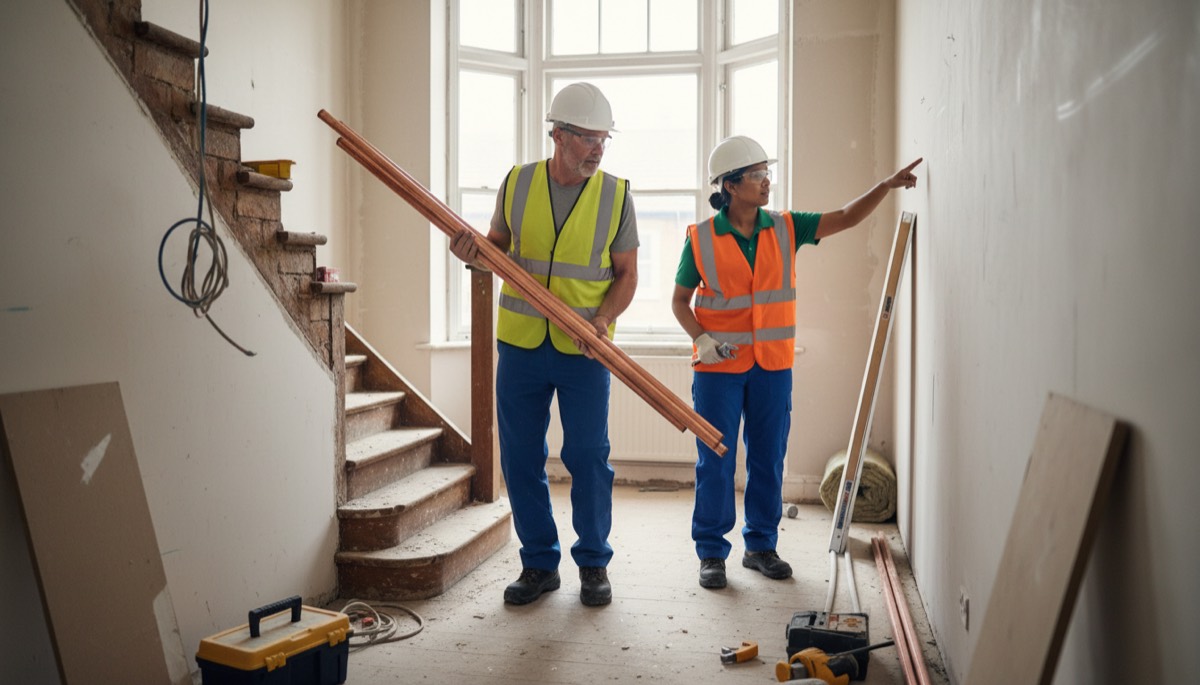
Route 2: College diploma, then NVQ
Many adults prefer to learn the basics first. A Level 2 college diploma, such as the City & Guilds 6035 Level 2 Diploma in Plumbing Studies (453 guided learning hours) or a BPEC foundation diploma, gives you a grounding in the trade and proves you are serious. Some colleges run evening or part-time versions, which can suit people who are still working. Ask your local colleges what they offer and what funding you might be eligible for.
Understand what you get at the end. A diploma is a route in, not a finishing line. JIB-PMES does not accept Level 2 vocational qualifications such as C&G 6035 for the Plumber Blue Card, and it says people who hold only technical certificates and are not continuing to an NVQ can apply only for the Green Card.
So plan the second half before you start the first. While you are studying, approach local plumbing firms and ask if they would take on a trainee once you have finished. Having a place lined up changes everything. Ask the college how it helps learners find employers, and how many of last year's learners ended up in plumbing work.
Route 3: The experienced worker route
If you have already been doing the job, you may not need to start from scratch. City & Guilds has a process for experienced workers on its 6188, 6189 and 6187 NVQ Diplomas.
Here is how it works, based on the City & Guilds guidance.
- Who it is for: workers currently in the industry with experience of a wide range of building services activities.
- The minimum: documentary evidence of at least three years' proven work experience, recorded on the experienced worker template.
- What it changes: you can use evidence from your workplace for the practical element of the combination units, instead of attending a training centre for those hours. For the 6189-11 Level 2 route, City & Guilds has a dedicated template and application document.
- What it does not change: all performance and knowledge units still need to be completed. Any learning outcomes the process does not cover must be achieved through the qualification's other assessment methods.
In short, the route reduces your time in a centre. It does not remove the assessment. You still need to do the work, sit the tests and let an assessor see you on site.
You must back up your history properly. The template asks for your job role, previous responsibilities and evidence that links to the assessment criteria. Have your work history, references and photographs ready before you speak to a centre. Assessors will want to see that your experience matches the unit content, not just that you have been around the trade for three years.
JIB-PMES has a matching card. The Experienced Worker Red Card is for people registered on a recognised Level 2 or 3 NVQ or equivalent, with at least three years' verifiable experience in the sector and a suitable health and safety test or units. It is valid for a maximum of three years and it cannot be renewed, so treat that as your deadline to finish.

Is a fast-track plumbing course a good idea?
Some private training centres sell intensive plumbing courses, often aimed at career changers. Some are good. But check precisely what you will receive.
An intensive course can teach you a lot about plumbing. It cannot give you the on-site evidence an NVQ requires, because the City & Guilds handbooks require performance-unit evidence to come from real work under real working conditions. Simulation is only for rare cases and for specified safety-critical activities.
Before you pay for any course, ask:
- What is the exact qualification, and what is its number? Then check whether JIB-PMES accepts it for a Blue Card.
- Is it a diploma or an NVQ Diploma? The names are close, but they are not the same thing.
- Who provides the on-site work and the assessor visits? "We'll help you find something" is not an answer.
- What is the total cost to reach a Blue Card? Include registration, assessment and tests.
- When does the qualification close? City & Guilds' 6189 NVQ Diplomas close to registrations on 31 December 2028, and its 6035 Level 3 Diploma on 31 December 2026.
- What happens if I cannot find work? Get the refund terms in writing.
If a provider promises you will be a fully qualified plumber in a few weeks, walk away. Our guide on how to become a plumber lays out what the qualified route really requires.
How to fund the change
Changing career is mostly a cash-flow problem. Work through these questions before you hand in your notice.
- What is the lowest income you can live on, and for how long? Mate wages are likely to be well below what you earn now.
- Can you keep your job and study part-time? An evening course can test your interest before you commit.
- Can you get funding? Funding for adult courses depends on your age, your location, your income and your existing qualifications. Ask a local college and the National Careers Service what you can get.
- What are your start-up costs? Tools, boots, work clothes and a card fee. JIB-PMES lists its standard card fee as £45.
- Do you need a van later? If you go self-employed, budget for the vehicle, insurance and stock.
Our advice is to treat the first year as an investment, and to line up the job before making the jump, if you possibly can.
How to find an employer who will take you on
This is the hardest part of the whole process, and it is where most career changers succeed or fail. It is also much easier than it sounds if you approach it like a job, rather than like a student.
- Make a list of local firms. Small plumbing and heating companies, bathroom fitters, housing maintenance teams and new-build subcontractors.
- Call or go in person. Small firms often do not advertise. A polite visit at 8am can do more than an online application.
- Sell what you already have. Reliability, a driving licence, customer service and experience of working in teams are all valuable.
- Offer something specific. Tell them you want to work as a mate, and that you want to register on an NVQ, and ask what they would need from you.
- Ask about a trial. A week or two lets both of you check whether it works.
- Keep track. Keep a list of who you contacted, then follow up after a few weeks.
Also look at larger housing associations, facilities management firms and local authorities. They sometimes run adult training schemes, and they tend to have steady work.
What your first year might look like
There is no standard timetable, because everything depends on your employer and the work available. Still, it helps to know what a sensible first year looks like, so you can tell whether things are on track.
| Stage | What should be happening | Warning sign |
|---|---|---|
| First weeks | Learning safe working, tools, and how the firm runs its jobs | No safety induction at all |
| First months | Doing supervised tasks: cutting, fixing, joining pipe, first fix | Only carrying materials and cleaning up |
| Around the time you are ready | Registered on an NVQ, with a named assessor and a Trainee Red Card | "We'll sort that out later", month after month |
| Rest of the year | Collecting evidence on varied jobs, attending centre units, assessor visits | Doing the same task every day, with no variety for your portfolio |
Review your progress with your employer every few months. If the firm cannot give you the range of work your units need, ask your assessor for advice on gaps. Moving to another firm is sometimes the honest answer.
Skills that transfer from other careers
You may be starting from further ahead than you think.
- Construction and maintenance: you already understand sites, safety and working with other trades.
- Armed forces and engineering: discipline, technical reading and hands-on problem solving are all useful. Some forces roles include relevant trade skills.
- Customer service and sales: in domestic plumbing, explaining a job and pricing it fairly is half the work.
- Business or admin: this is valuable if you plan to go self-employed later.
Tell employers about these skills. A reliable 40-year-old who can talk to customers may be more useful to a small firm than a school leaver.
Mistakes career changers often make
- Quitting first and planning later. Line up the income or the job before you leave.
- Buying tools too early. Start with a basic set and buy more when you know what your work needs.
- Paying for several courses at once. Take one step at a time, and confirm that each one leads to the next.
- Ignoring English and maths. You will need measurements, calculations and customer paperwork. If your skills are rusty, sort that out early.
- Assuming gas comes with plumbing. It does not. Plan for it as a separate stage.
Which route should you choose?
| If this sounds like you | Choose |
|---|---|
| I need to earn now and I can find a firm | Plumber's mate, then NVQ |
| I want to try it before I commit | Part-time college course while still working |
| I have the savings to study first | College diploma, with an employer lined up |
| I've been doing plumbing work for 3+ years | Experienced worker route |
| I can find an employer who will take an adult apprentice | Adult apprenticeship |
Then think about the level you are aiming for. WaterSafe accepts a Level 2 NVQ with a Water Regulations certificate as its minimum, and recommends Level 3 for full competence. Adults who plan to run their own business should plan for Level 3 at some stage, and for gas, if that is the work they want.
Frequently asked questions
Can I become a plumber at 40 or 50?
Yes. There is no upper age limit on the qualifications or the card scheme. The practical questions are whether you can manage on lower earnings while you train and whether the physical work suits you. Life experience and customer skills are real advantages in domestic plumbing.
Can I learn plumbing online?
You can learn some theory online, but you cannot qualify that way. An NVQ requires evidence from real work, and practical skills need to be practised and assessed. Treat any online course as a supplement.
Do I need an employer to do a plumbing NVQ?
In practice you need access to real plumbing work, which usually means an employer. The City & Guilds handbooks require evidence from real work activities under real working conditions. Self-employed people with real work may be able to use that, so ask a centre.
How long does the experienced worker route take?
City & Guilds does not set a fixed time, because it depends on your evidence and how much of the qualification you still need to complete. Be sceptical about short timescales. All performance and knowledge units still have to be completed, and your experienced worker card lasts three years at most.
What counts as experienced worker evidence?
City & Guilds asks for documentary evidence of at least three years' proven work experience, recorded on its template. That usually includes your work history, job role and details of work that link to the assessment criteria. Your centre will tell you what it accepts.
Can I work as a plumber while I am qualifying?
Yes, as a trainee or mate working under suitable supervision, and many people do. Be careful with anything you sign off or do on your own. Gas work in particular needs its own competence and registration, and you cannot do it simply because you are training as a plumber.
Is an adult apprenticeship better than these routes?
It can be, if you can find an employer and manage on the wage. The apprenticeship has a typical duration of 48 months, with a clear structure and funded training. The routes in this guide suit people who cannot find an apprenticeship, or who already have relevant experience.
How Nexis Academy can help
Nexis Academy is a City & Guilds Approved Centre (T91185) in Manchester. We currently deliver internal wall insulation training, with more trade and construction courses in development. We do not yet offer plumbing courses, so please register your interest to hear when that changes.
See also how the plumbing NVQ portfolio works.
Sources
- City & Guilds, 6188-6189 experienced worker route guidance: three-year minimum, what the route changes.
- City & Guilds, 6189 Plumbing and Domestic Heating, Level 2 handbook and Level 3 handbook.
- City & Guilds, Plumbing Craft (6035).
- JIB-PMES, Plumber Blue Card, Trainee Red Card, Experienced Worker Red Card and card types.
- National Careers Service, Plumber job profile.
- WaterSafe, Do you recommend trainee plumbers to aim for a particular NVQ level?
- Skills England, Plumbing and domestic heating technician (ST0303 v1.2).