

The portfolio is the part of the NVQ that most learners find hardest, and it is rarely because the plumbing is difficult. It is because evidence has to be planned, collected at the right time and recorded properly. This guide explains how it works, using the City & Guilds 6189 NVQ Diplomas, the most widely used plumbing NVQs, as the example. Other awarding organisations work in a similar way, but check your own centre's requirements.
How a plumbing NVQ is structured
The City & Guilds 6189 NVQ Diplomas are made up of three kinds of unit.
| Unit type | How it is assessed | Where |
|---|---|---|
| Knowledge units | Multiple-choice tests and assignments | In the assessment centre |
| Combination units | A mix of knowledge and practical activities in simulated conditions | In the centre |
| Performance units | Evidence from your real work | On site, in your workplace |
At Level 2 (6189-11), the qualification has 596 guided learning hours and a total qualification time of 760 hours. The units include safe working practices, communication, environmental protection, scientific principles, pipework fabrication, and the cold water, hot water, central heating, rainwater and above-ground drainage systems. The performance units include Unit 019, applying safe working practices, and Unit 020, installing and maintaining domestic plumbing and heating systems.
The performance units are where the portfolio lives. The handbook says they are assessed by observation and the development of a portfolio in a working environment, recorded in the City & Guilds 6189 logbook or an approved e-portfolio.
What counts as evidence?
The handbook says evidence from the real working environment for performance units must occur naturally. That means it should come from work you were doing anyway, not from jobs set up for the assessment. It lists the types of evidence:
- Direct observation of your work by a qualified assessor, and/or testimony from an expert witness. The handbook calls this the primary source of evidence.
- Your reflective account, in which you explain what you did and why.
- Work plans and work products: diagrams, drawings, specifications, customer testimony, and authorised and authenticated photographs, images and video records of completed work.
- Evidence from prior achievements that clearly match the unit requirements.
- Witness testimony.
For Unit 020 at Level 2, the guidance also allows product assessment of completed work by a qualified plumbing assessor, and a professional review of your competence by a qualified assessor. Witness testimony in a logbook must be countersigned by a qualified expert witness from your company.
Who can be an expert witness?
An expert witness is someone in your industry who can vouch for what you did. City & Guilds says expert witnesses must be competent in the sector. They do not need an assessor qualification, because a qualified assessor still judges the evidence. They must have current knowledge of industry working practices and techniques, and no conflict of interest in the outcome.
Typically that means a qualified plumber or supervisor at your firm. Their testimony must still pass the standard tests of validity, reliability, authenticity and sufficiency, so a vague signature on a page is not enough.
The minimum evidence rules: Level 2 Unit 020
The Level 2 handbook sets out exactly what Unit 020 needs. It is worth knowing these rules before you start, because they decide which jobs you need.
All evidence must come from your workplace. The handbook is explicit that simulated assessment activities are not acceptable for this unit.
Installing and soundness testing (learning outcomes 1 to 3):
- Show work on at least three of five system types: cold water, hot water, central heating, sanitation and gravity rainwater.
- For each of those three, show the assessment criteria met on two separate occasions, which means at least two different jobs at different addresses.
The handbook also defines the minimum scope of each job:
| System | Minimum job scope | Minimum direct observation |
|---|---|---|
| Hot and cold water | A bath or shower, basin and WC in a dwelling, as a new or replacement bathroom suite, including complete replacement of hot and cold pipework in the room. Or three appliances in a commercial setting, two of different types | Installing one sanitary appliance and its pipework, at one address |
| Central heating | A new or replacement system with at least 4 radiators, controls and connections to the boiler, with new or completely replaced pipework | Installing one radiator and its pipework connections to the heating mains, at one address |
| Sanitation | Installing or completely replacing a soil pipe and venting to a bathroom suite (bath or shower, basin and WC), or a commercial equivalent including a WC | Installing one sanitary appliance and its soil or waste connection to the stack, at one address |
| Gravity rainwater | New or completely replaced gutters and downpipes on a property | A significant section of gutter or a complete section of downpipe, at one address |
Electrics and the fuel supply are excluded from the scope of the central heating assessment.
Decommissioning (learning outcome 4): show work on at least two of four system types (cold water, hot water, central heating, sanitation), with the criteria met once at a property for each.
These rules explain why a learner whose employer does nothing but repairs and small jobs can get stuck. A dripping tap does not meet the scope of a bathroom installation. If your work does not cover the required jobs, raise it with your employer and assessor early.
What gets simulated, and why
Some activities are too dangerous to assess on a customer's live system. The Level 3 handbook lists the safety-critical activities that must be assessed under simulated conditions:
- F-gas installation, service and maintenance
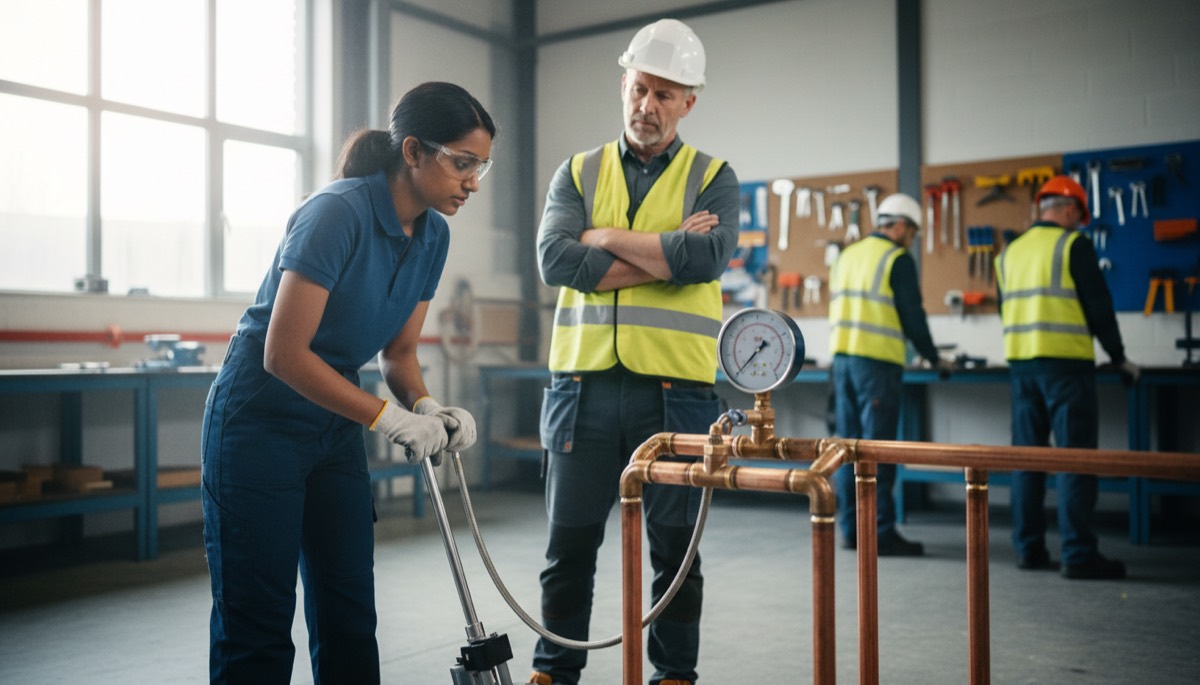
- pressure testing
- refrigerant handling
- thermal pipe joining: welding, brazing and soldering
- limited scope electrical work
- gas, oil and solid fuel systems, as relevant
- unvented hot water and backflow prevention, as relevant
These assessments come under each industry's own arrangements for assessing occupational competence. They must not take place until the learner has shown enough technical expertise, knowledge, skill and maturity, and any simulation must take place in a realistic working environment.
Outside those safety-critical activities, the handbooks say simulation in a performance unit should be rare. It is allowed only where natural opportunities to collect evidence are limited or absent, and the centre must get approval from the external verifier first. Do not plan on using it.
How the assessor visit works
Your assessor is the person who judges your evidence. Expect the following.
- Planning. At the start, you and your assessor agree an assessment plan: which units, which jobs, and when they will visit.
- Observation visits. The assessor watches you work on a real job, and asks questions to check your understanding.
- Product checks. They look at work you have finished, often alongside your photos and records.
- Questioning and professional discussion. They ask how you would handle different situations, or why you did something a certain way.
- Review and feedback. They tell you what counts, what is missing and what to collect next.
Make it easy for them. Tell your assessor about good jobs coming up, such as a full bathroom or a new heating system, so they can visit when the evidence is happening. Make sure the customer and your employer are happy for an assessor to attend.
Step by step: building a portfolio that passes
- Read the unit requirements before you start. Know the system types, the minimum scope and the observation requirements.
- Map your upcoming jobs against the requirements. Write down which job could cover which requirement.
- Record every relevant job as you go. Note the address, date, job description and your role.
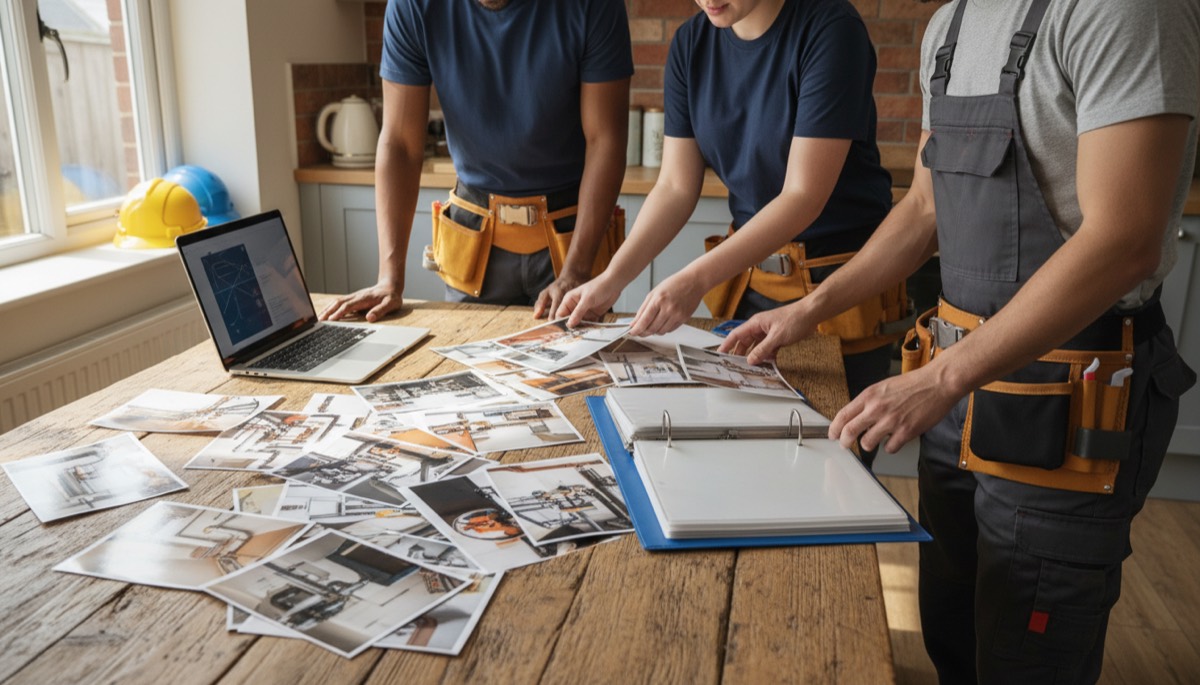
- Take authenticated photographs. Get permission from your employer and the customer, and take shots before, during and after. Avoid capturing personal details or anything that identifies the customer.
- Write short reflective accounts while the job is fresh. Explain what you did, why, and how you tested it.
- Get witness testimony signed promptly. Ask your supervisor to countersign while they remember the job.
- Book observations for the right jobs. Plan visits around the jobs that meet the minimum direct observation requirements.
- Review gaps every month. With your assessor, check what is still missing, and ask your employer for that type of work.
Example: mapping your jobs to the evidence you need
A simple planning sheet makes a huge difference. Here is an example of how a Level 2 learner might map upcoming jobs to the Unit 020 requirements. The addresses are illustrative.
| Job | Address | System types covered | Could include direct observation? | Evidence to collect |
|---|---|---|---|---|
| Full bathroom replacement | Job A | Hot and cold water, sanitation | Yes: installing a sanitary appliance and its pipework | Photos before, during and after; witness testimony; reflective account |
| New heating system, 6 radiators | Job B | Central heating | Yes: installing a radiator and connections | Photos, pipework layout, test record, testimony |
| Second bathroom replacement | Job C | Hot and cold water, sanitation (second occasion) | Optional | Photos, testimony, reflective account |
| Gutter and downpipe replacement | Job D | Gravity rainwater | Yes: a section of gutter or downpipe | Photos, testimony |
| Second heating system | Job E | Central heating (second occasion) | Optional | Photos, test record, testimony |
| Old cylinder removal | Job F | Hot water decommissioning | Not required | Photos, reflective account, testimony |
In this example, the learner would have three system types (hot and cold water, sanitation and central heating), each on two separate jobs, plus rainwater as a fourth option and decommissioning evidence. Your assessor will confirm what your own plan needs.
What a good reflective account includes
Reflective accounts are your own description of a job. Done well, they show the assessor that you understand what you did, not just that you did it. Include:
- The job: where, when, and what the customer needed.
- Your role: what you did yourself, and what you did with help.
- The method: how you prepared the site, which materials and fittings you used, and why.
- Safety: how you isolated supplies, protected the property and worked safely.
- Testing: how you soundness tested or commissioned the work, and what the results were.
- Problems: anything unexpected, and how you dealt with it.
Keep them short and factual. A clear page written the same day is worth more than three pages written from memory.
Photos, customers and personal data
Photographs are valuable evidence, but they are taken in people's homes. Always get permission from your employer and the customer. Avoid capturing faces, house numbers, documents and other personal details. Store them securely, and only share them through your centre's approved logbook or e-portfolio. Your centre should explain how it handles personal data. If in doubt, ask before you take or share a photo.
Common reasons portfolios get stuck
- Not enough variety. Doing the same type of job repeatedly does not meet the requirements for different system types.
- Jobs too small. The scope requirements are specific, for example four radiators and complete pipework replacement for central heating.
- Evidence collected too late. Photos and testimony gathered months afterwards are weaker and harder to authenticate.
- No observation booked. Some requirements must be observed directly by a qualified assessor.
- Working alone without a witness. If nobody saw the work, it is harder to prove.
- Knowledge tests left until last. Book them while you are collecting evidence, rather than finishing your site work and then waiting for tests.
Can you do a plumbing NVQ without a job?
In practice, you need access to real plumbing work. The handbooks require performance-unit evidence to come from real work activities under real working conditions, and centres must be sure you have both the potential and the opportunity to achieve the qualification.
That usually means working for a plumbing employer. Self-employed plumbers with suitable work may be able to use their own jobs. If you have neither, see our guide to how to become a plumber without an apprenticeship, which covers the plumber's mate and college routes.
If you have at least three years of proven work, City & Guilds' experienced worker route lets you use workplace evidence for the practical element of the combination units. All performance and knowledge units still need to be completed.
What happens when you finish?
Once your assessor and the centre's internal quality assurance are satisfied, the centre claims your certificate from City & Guilds. With a Level 2 NVQ Diploma you can apply for the JIB-PMES Plumber Blue Card, and with a Level 3 NVQ Diploma for the Gold Card, as long as you meet the health and safety requirements. Our guide to Level 2 vs Level 3 plumbing qualifications explains which to aim for.
Keep a copy of your portfolio. It is a record of your experience that can help with later qualifications and registrations, and with jobs.
If you enjoy the assessment side of the process, it can become a career too. Experienced plumbers can train as NVQ assessors. Our guide to the CAVA assessor qualification explains how.
Frequently asked questions
How long does a plumbing NVQ take?
City & Guilds lists 596 guided learning hours and 760 hours of total qualification time for the Level 2 NVQ Diploma, but how long it takes you depends mostly on how quickly you can collect the required evidence on real jobs. A learner with varied work and regular assessor visits will finish much faster than one doing repetitive tasks.
Can I use photos as evidence for my plumbing NVQ?
Yes. The handbooks list authorised and authenticated photographs, images and audiovisual records among the acceptable work products. Photos usually support other evidence, such as observation or witness testimony, and some requirements must be observed directly by a qualified assessor.
What is an expert witness in a plumbing NVQ?
A sector-competent person, usually a qualified plumber or supervisor, who can vouch for your performance at work. They do not need an assessor qualification, but they must have current industry knowledge and no conflict of interest. A qualified assessor still judges their evidence.
Can simulated work count towards a plumbing NVQ?
For Level 2 Unit 020, City & Guilds says simulated activities are not acceptable. Safety-critical activities such as pressure testing, thermal pipe joining and unvented water are deliberately assessed under simulated or controlled conditions. Other simulation in performance units is rare and needs approval first.
Do I need my own assessor?
Your centre provides the assessor. Ask how often they visit, how to book observations, and how to contact them between visits. If you are struggling to get assessor visits, raise it with the centre early.
Does my employer have to agree to the NVQ?
Your employer needs to support it in practice, because you need varied work, assessor visits on their jobs, and witness testimony from their staff. Talk to them before you register.
What is the difference between the logbook and an e-portfolio?
They are two ways of recording the same evidence. City & Guilds offers a 6189 logbook, and also endorses approved e-portfolio systems. Your centre will tell you which one it uses.
How Nexis Academy can help
Nexis Academy is a City & Guilds Approved Centre (T91185) in Manchester. We currently deliver internal wall insulation training, with more trade and construction courses in development. We do not yet offer plumbing courses, so please register your interest to hear when that changes.
See also how to become a plumber.
Sources
- City & Guilds, Level 2 NVQ Diplomas in Plumbing and Heating handbook v3.4: units, assessment methods, evidence types, expert witnesses, Unit 020 minimum evidence requirements.
- City & Guilds, Level 3 NVQ Diplomas in Domestic Plumbing and Heating handbook v6.4: safety-critical simulation, occupational competence arrangements.
- City & Guilds, 6188-6189 experienced worker route guidance: unit types, workplace evidence, three-year minimum.
- City & Guilds, 6189 Plumbing and Domestic Heating: hours and dates.
- JIB-PMES, Plumber Blue Card and Plumber Gold Card.