
That last point catches many people out. Nothing stops you calling yourself a plumber, so the industry relies on qualifications, cards and registration schemes to separate competent people from everyone else. This guide explains how those fit together, which route suits you, and what to watch for before you spend money on a course.
What does a plumber actually do?
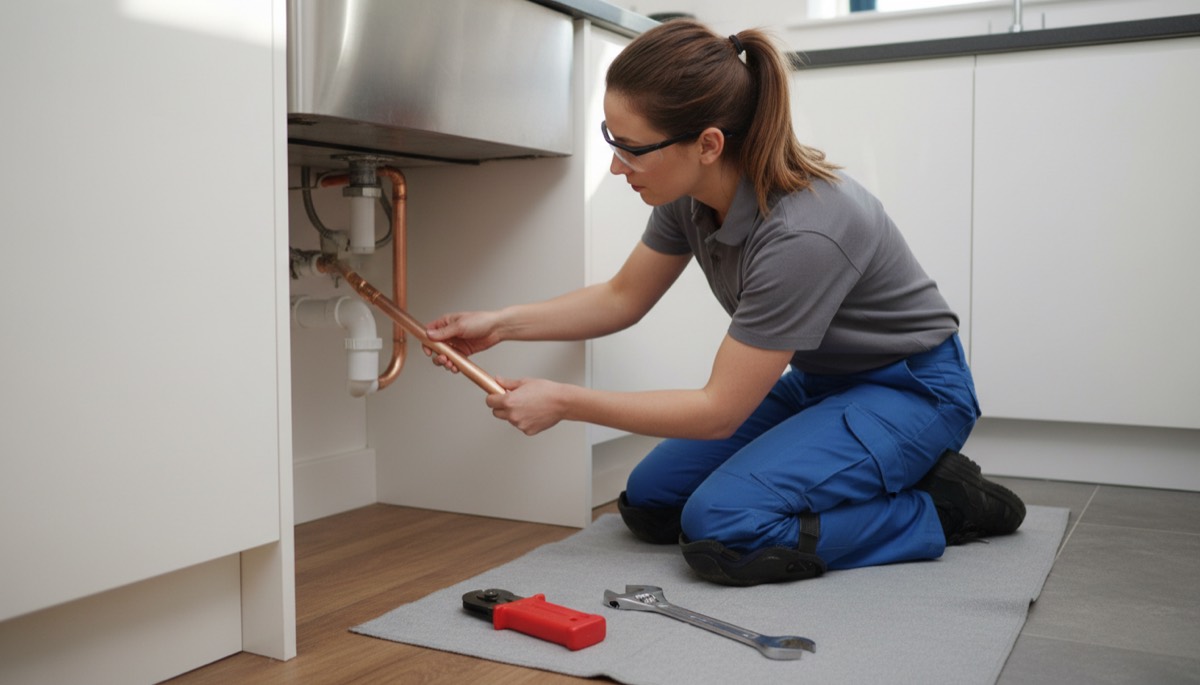
Plumbers install and repair the systems that move water around a building. The National Careers Service lists the core work as installing and repairing water, heating and drainage systems, cutting and joining pipes and fittings, servicing heating systems and radiators, responding to emergency call-outs, and fitting weatherproof materials and flashings to roofs, chimneys and walls.
Day to day, that work falls into a few broad areas:
- New build: first-fix and second-fix pipework on housing or commercial sites, usually for a subcontractor.
- Domestic installation: bathrooms, kitchens, hot water cylinders and heating upgrades in people's homes.
- Service and repair: leaks, blockages and breakdowns, often with call-out work.
- Commercial and public buildings: larger pipework systems in schools, hospitals and offices.
Most plumbers in homes also work on central heating, and that is why the qualifications are usually called "plumbing and domestic heating". Be aware that gas is a separate legal step. Learning about heating does not allow you to work on a gas boiler. For that you need gas competence and registration, which is covered below.
The National Careers Service gives typical hours of 37 to 45 a week, with evenings, weekends and bank holidays possible, and salaries from about £24,000 for a starter to about £46,000 when experienced. Use those as broad government estimates. Your own earnings will depend on your region, specialism and whether you are employed or self-employed.
Do you legally need a qualification to be a plumber?
There is no single licence for plumbing in the UK. Instead, the law regulates particular types of work.
- Water regulations. The Water Supply (Water Fittings) Regulations 1999 apply in England and Wales to mains-fed water systems. Scotland and Northern Ireland have their own equivalents. Certain work must be notified to the water company before it starts, unless it is carried out by an approved contractor. Owners, occupiers and installers can all carry responsibility for compliance.
- Gas. The National Careers Service states that you need Gas Safe registration to work on domestic gas heating systems. A plumbing qualification alone does not give you that.
- Building Regulations. Work such as unvented hot water systems must meet the Building Regulations. The City & Guilds NVQ handbook treats unvented hot water as a separate safety-critical competence area.
Beyond the law, customers and employers set their own bar. Contractors and main contractors usually want to see a card. Homeowners increasingly look for a registered plumber. WaterSafe, the national register of approved plumbers, treats a Level 2 NVQ with a Water Regulations certificate as its minimum, and recommends Level 3 for full competence.
What qualifications do you need?
Plumbing qualifications come in two types, and confusing them is the most expensive mistake in this trade.
| Type | Examples | What it proves |
|---|---|---|
| Knowledge and practical diploma | City & Guilds 6035 Level 2 Diploma in Plumbing Studies, BPEC Level 2 Diploma in Plumbing Foundation | You have learned the basics, usually in a college workshop |
| Competence qualification | City & Guilds 6189 NVQ Diplomas, the Level 3 apprenticeship | You have done the work to standard, on real jobs, with an assessor checking |
The JIB-PMES card scheme, which is the plumbing industry's main card, draws exactly this line. It accepts a Level 2 NVQ Diploma for the Plumber Blue Card, but it does not accept a Level 2 vocational qualification such as City & Guilds 6129 or 6035. It says applicants who hold only technical certificates and are not continuing to an NVQ can apply only for the Labourer/Plumber's Mate Green Card.
So a college diploma is a useful first step, but it should be a step towards something. City & Guilds says its 6035 qualifications are for people wanting to enter the plumbing industry, and lists progression to an NVQ or apprenticeship.
For the full comparison between the two levels, read our guide to Level 2 vs Level 3 plumbing qualifications.
The main routes into plumbing
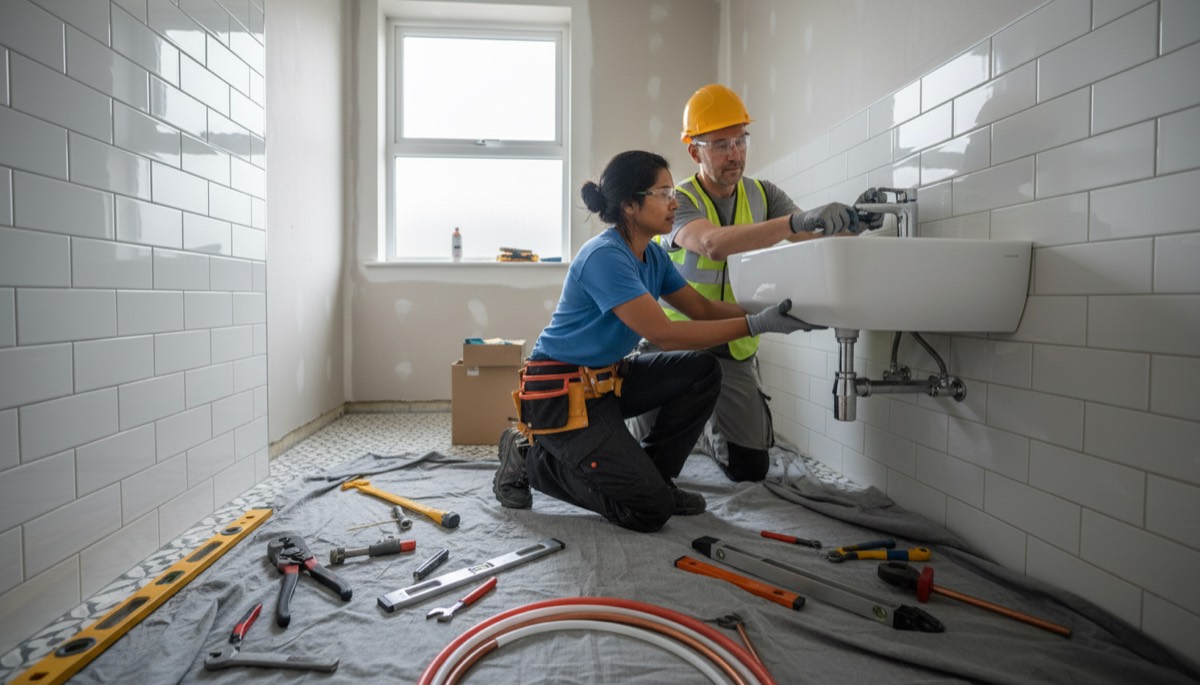
There are four common routes. The right one depends on your age, your finances and whether you already have an employer.
| Route | Best for | Typical length | Outcome |
|---|---|---|---|
| Level 3 apprenticeship | School leavers and anyone with an employer | About 4 years | Level 3 Diploma and end-point assessment; accepted for the Gold Card |
| College, then NVQ | People who want to learn before finding an employer | Depends on how quickly you find site work | Level 2 NVQ Diploma, then Level 3 |
| Plumber's mate, then NVQ | Adults who need an income while they learn | Depends on your employer and the work available | NVQ Diploma, with a Trainee Red Card while you train |
| Experienced worker | People already working in the trade for 3+ years | Depends on evidence and units | NVQ Diploma with some alternative evidence accepted |
The apprenticeship route
The main route in England is the Level 3 Plumbing and domestic heating technician apprenticeship (standard ST0303). Skills England gives a typical duration of 48 months, with an end-point assessment period of about 6 months. Every apprentice completes a Level 3 Diploma in plumbing and domestic heating, and the standard offers three specialisms: domestic gas-fired hot water and heating appliances, domestic air source heat pumps and solar thermal systems, or non-domestic plumbing.
The gas specialism includes ACS gas assessments, which makes it the most direct way of combining plumbing and gas. Apprentices earn while they learn, and their training costs are normally covered through the apprenticeship system.
The National Careers Service says Level 3 apprenticeships usually ask for 5 GCSEs at grades 9 to 4, including English and maths, or equivalent, although employers set their own requirements.
Two changes are worth watching. Skills England marks ST0303 as being revised, while it remains approved for delivery. And in February 2025 the Chartered Institute of Plumbing and Heating Engineering (CIPHE) announced approval to develop new Level 2 and Level 3 plumbing apprenticeship standards. Check which standard is on offer when you apply.
The college route
Many people start with a full-time or part-time college course, such as the City & Guilds 6035 Level 2 Diploma in Plumbing Studies (453 guided learning hours) or a BPEC foundation diploma. The National Careers Service says college entry varies, and that 4 or 5 GCSEs at grades 9 to 4 are typical. T Levels are another option for school leavers, such as Building Services Engineering for Construction.
The college route gives you a real base of knowledge and a practice workshop. Its weakness is what comes next: you still need a job on real sites to finish an NVQ. Before you enrol, ask the college how many learners move on to employment, and what help they give you to find it.
The adult routes
If you are changing career, an apprenticeship is possible at any age but it is not your only option. We cover the alternatives in our guide to how to become a plumber without an apprenticeship. This includes the plumber's mate route and the experienced worker route.
Step by step: from beginner to qualified
Whichever route you choose, the journey follows the same broad steps.
- Decide the work you want. Domestic, commercial, new build or service. This shapes the route and the card you need.
- Check your English and maths. Many apprenticeships and colleges ask for them, and you will use both daily.
- Pass a health and safety test. JIB-PMES cards require evidence that you meet its Health, Safety and Environment test criteria.
- Find an employer or a college place. Without an employer, plan how you will find one.
- Register for a recognised qualification. Confirm the qualification number and awarding organisation.
- Build your evidence on real jobs. Your assessor observes you, and you record your work.
- Complete your safety-critical assessments. These are often separate, as explained below.
- Apply for your card. Blue with a Level 2 NVQ Diploma, Gold with Level 3.
- Add specialist tickets and registration. Water regulations, unvented hot water, and gas if you want it.
What is an NVQ, and why does it matter so much?
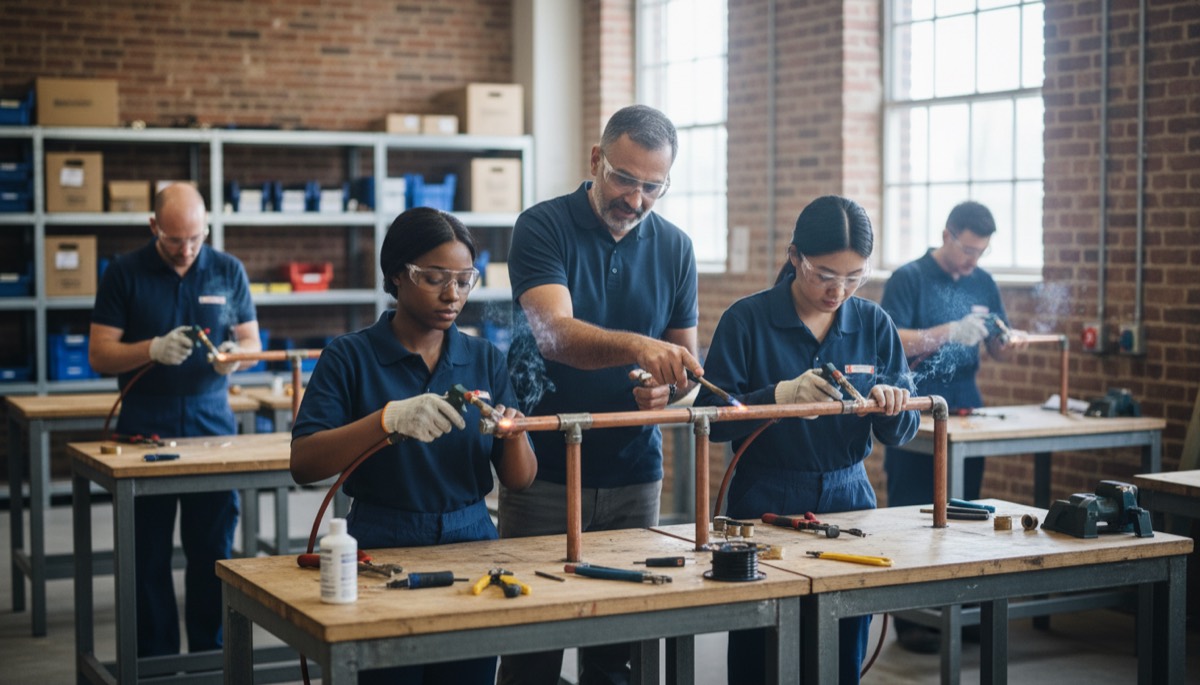
The NVQ is what turns training into proof. The City & Guilds 6189 handbooks are clear that evidence for performance units must come from real work activities, under real working conditions. Simulation is only for rare cases, except that safety-critical activities must be simulated. Those include pressure testing, thermal pipe joining, limited scope electrical work, gas, oil and solid fuel, and unvented water. These activities are assessed under the industry's own occupational competence arrangements, not on someone's live job.
The City & Guilds figures show how substantial these qualifications are:
| Qualification | Guided learning hours | Total qualification time | Last registration date |
|---|---|---|---|
| 6189-11 Level 2 NVQ Diploma in Plumbing and Heating | 596 | 760 | 31 December 2028 |
| 6189-31 Level 3 NVQ Diploma in Domestic Plumbing and Heating | 549 to 659 | 680 | 31 December 2028 |
| 6189-33 Level 3 NVQ Diploma (Gas Fired Water and Central Heating Appliances) | 1,034 | 1,460 | 31 December 2028 |
Assessors can use direct observation, expert witness testimony, your own reflective accounts, and work products such as drawings, customer testimony and authenticated photographs. Get into the habit early of recording your jobs properly. Your phone is a useful assessment tool if the employer and customer agree.
There are no formal entry requirements for the 6189 NVQ Diplomas, and City & Guilds does not accept candidates under 16. But centres must be sure you have the opportunity to complete them, and in practice that means access to real plumbing work.
Which cards do plumbers need?
Most site work asks for a card. The plumbing industry's main scheme is run by JIB-PMES, the Joint Industry Board for Plumbing and Mechanical Engineering Services, and it carries the CSCS logo.
| Card | Who it is for | Key requirement |
|---|---|---|
| Labourer / Plumber's Mate Green | Mates and labourers | Includes people with only technical certificates |
| Trainee Red | Trainees | Registered on a Level 2 or 3 NVQ, employed in the industry |
| Apprentice Red | Apprentices | On a recognised apprenticeship |
| Experienced Worker Red | Experienced workers qualifying now | 3+ years' verifiable experience and registered on an NVQ |
| Plumber Blue | Qualified plumbers | Level 2 NVQ or NVQ Diploma, or accepted equivalent |
| Plumber Gold | Advanced plumbers | Level 3 NVQ, NVQ Diploma, apprenticeship standard or accepted equivalent |
JIB-PMES says Blue and Gold cards are valid for up to five years. The standard fee is £45, and fast track adds £60, with free cards for some union members and participating employers' staff.
A card is not a legal requirement in itself. Principal contractors decide what they accept, and most building sites will expect a card. If you only work for homeowners you may never be asked, but the qualification behind it still matters for customers, insurers and registration schemes.
How much does it cost to become a plumber?
The cost depends far more on the route than on the qualification.
- Apprenticeship: you earn a wage, and your training is normally funded through the apprenticeship system. This is usually the lowest-cost route, but the wage may be low at the start.
- College: fees and funding vary by age, previous qualifications and college. Ask the college what you are entitled to before you assume you must pay.
- Private training centres: usually the most expensive route. Compare the full cost, including tools, registration and assessment, and what happens after the course.
Budget for extras on any route: hand tools, work clothing and boots, a card fee, and later tickets such as water regulations, unvented hot water and gas. We have not quoted course prices here because they vary widely and change often. Get any quote in writing, and ask what it includes.
Mistakes to avoid
- Buying a course that stops at a diploma. Check that a clear route to an NVQ exists, including who will provide the on-site work.
- Assuming plumbing includes gas. It does not. Gas needs its own competence and registration.
- Registering on a closing qualification. City & Guilds' 6035 Level 3 Diploma closes to registrations on 31 December 2026, and it is being replaced by the 6036-03 Level 3 Technical Occupational Entry in Plumbing and Heating. The 6189 NVQ Diplomas close to registrations on 31 December 2028. Ask what you are registering for, and how long you have to finish.
- Not recording your work. Evidence is much harder to collect later. Start your portfolio from the first week.
- Paying for a package you do not need. Take one qualification at a time. Confirm with an employer what they actually want.
What happens after you qualify?
Qualifying is the start of a career with many directions.
- Specialise. Gas, unvented hot water, commercial plumbing or water regulations work.
- Go self-employed. Many plumbers run their own business, often joining a registration scheme such as WaterSafe's approved contractors.
- Supervise and manage. Move into site supervision or contract management.
- Teach. Experienced plumbers are needed in colleges and training providers. Our guide on how to become a trade tutor explains the route, and the assessing and quality assurance roles that come with it.
Frequently asked questions
How long does it take to become a plumber?
The Level 3 apprenticeship has a typical duration of 48 months. Other routes depend on how quickly you can get varied work on real jobs. Be wary of anyone promising a fully qualified plumber in a few weeks. Short courses can teach skills, but they cannot provide the on-site evidence an NVQ requires.
Do I need GCSEs to become a plumber?
Not always. The National Careers Service says Level 3 apprenticeships usually ask for 5 GCSEs at grades 9 to 4, including English and maths, while college requirements vary. The 6189 NVQ Diplomas have no formal entry requirements. If you lack GCSEs, ask a college about English and maths courses or a lower-level start.
Can I be a plumber with just a Level 2?
Yes. A Level 2 NVQ Diploma supports a JIB-PMES Blue Card, and WaterSafe accepts Level 2 with a Water Regulations certificate as its minimum. WaterSafe recommends Level 3 for full competence, and a Level 2 college diploma without the NVQ will not qualify you for the Blue Card.
Do plumbers need a CSCS card?
Not by law, but most principal contractors expect one on building sites. For plumbing, the usual card is a JIB-PMES card carrying the CSCS logo, rather than a generic labourer's card. If you work only in homes you may not be asked for one.
Do plumbers need to be registered?
There is no general legal register of plumbers. Gas work is different, since you must be Gas Safe registered. Water regulations also apply, and approved contractor schemes such as those under WaterSafe allow certain notifiable work to be certified without notifying the water company in advance.
Can I start as a plumber's mate?
Yes. The National Careers Service lists starting as a plumber's assistant or mate as a recognised way in. Choose an employer who will support you onto an NVQ, otherwise you can spend years gaining experience without a qualification.
How much do plumbers earn?
The National Careers Service gives about £24,000 a year for starters and about £46,000 when experienced. Self-employed earnings vary widely, and depend on your region, your specialism and your running costs.
How Nexis Academy can help
Nexis Academy is a City & Guilds Approved Centre (T91185) in Manchester. We currently deliver internal wall insulation training, with more trade and construction courses in development. We do not yet offer plumbing courses, so please register your interest to hear when that changes.
See also the G3 unvented hot water qualification, do plumbers need to be registered? and how the plumbing NVQ portfolio works.
Sources
- National Careers Service, Plumber job profile: duties, routes, entry requirements, hours, salary.
- Skills England, Plumbing and domestic heating technician (ST0303 v1.2): duration, specialisms, mandatory qualifications.
- City & Guilds, 6189 Plumbing and Domestic Heating, Level 2 handbook and Level 3 handbook.
- City & Guilds, Plumbing Craft (6035).
- JIB-PMES, Plumber Blue Card, Plumber Gold Card and card types.
- WaterSafe, Do you recommend trainee plumbers to aim for a particular NVQ level?
- Water Supply (Water Fittings) Regulations 1999.
- Engineering Council, New Level 2 and 3 apprenticeship standards for plumbing, February 2025.