
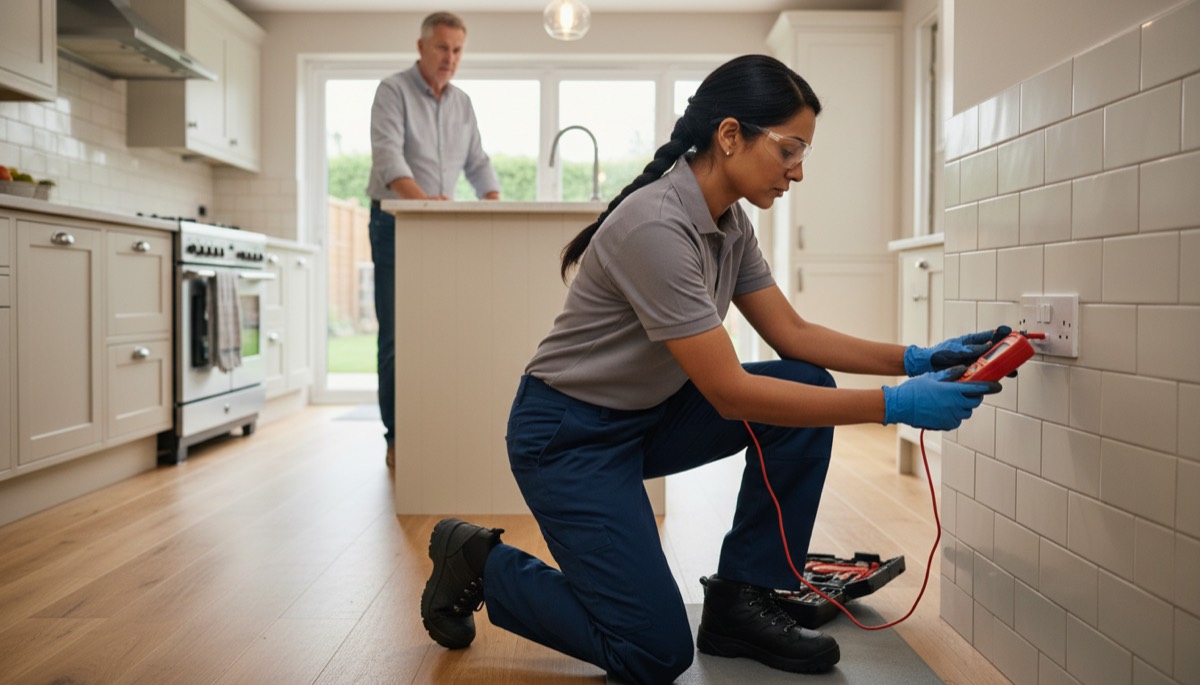
The confusion comes from treating one word as if it meant one thing. "Electrician", "domestic installer" and "Part P electrician" are not legally protected titles. What actually decides what someone can do is a combination of three separate things: what they are competent to do, what their qualifications and card show, and whether they are registered with a scheme.
Is it illegal to do electrical work without being an electrician?
No. There is no general law in England or Wales that says only a qualified electrician may do electrical work. The Electrical Contractors' Association says plainly that anyone can do electrical work in a dwelling, including a householder, provided the work complies with Part P of the Building Regulations.
That freedom has real limits, and two pieces of law set them.
- Part P of the Building Regulations applies to dwellings in England and Wales. It requires reasonable provision to protect people from fire and injury, and it requires certain work to be certified. Failing to notify notifiable work can be an offence, and the local authority can require non-compliant work to be altered or removed. Electrical Safety First warns homeowners and landlords that they must be able to show their electrical work meets Part P.
- The Electricity at Work Regulations 1989 apply to work activities. Regulation 16 says nobody should do work where technical knowledge or experience is needed to prevent danger unless they have that knowledge or experience, or are suitably supervised.
So the law is not interested in your job title. It is interested in whether the work is safe, whether you were competent to do it, and whether the right work has been certified the right way.
The three things people mix up: qualification, card and registration
Most arguments about "domestic installers" come from mixing up three different things. They are held by different people, issued by different bodies, and they prove different things.
| What it is | Who gives it | What it proves | |
|---|---|---|---|
| Qualification | Level 3 electrotechnical qualification and AM2 assessment | Awarding organisation, plus NET for the AM2 | You have been trained and assessed as occupationally competent |
| Card | ECS card, such as the Gold Card | JIB, through the Electrotechnical Certification Scheme | You can show your qualifications and safety awareness on site |
| Registration | Membership of a competent person scheme | Scheme operators such as NICEIC, ELECSA or NAPIT | Your business can self-certify notifiable work in dwellings |
Notice who holds what. A qualification and a card belong to a person. Registration belongs to the business, which is assessed and then monitored by the scheme. Someone can hold all three, any two, or just one.
This is why the question "is a domestic installer qualified?" has no single answer. Some people on a domestic scheme have a full apprenticeship and an ECS Gold Card, and have simply chosen to work in homes. Others hold a Level 3 domestic qualification. Others came through older routes and have been registered for years.
What is a domestic installer?
"Domestic installer" is not one defined qualification. In everyday use it means an electrical worker whose work is limited to homes, and it usually refers to a business registered with a scheme. NICEIC's Domestic Installer scheme is the best-known example of the name.
The scheme rules come from the Electrotechnical Assessment Specification (EAS), the document that sets minimum technical competence for enterprises doing electrical work in dwellings under Part P. The June 2026 edition is the current one. Under it, each registered business needs a Qualified Supervisor, a named person responsible for the technical standard of the work.
The EAS sorts work into categories. These two matter most here:
- A1.1 Dwellings: electrical installation work in homes.
- A1.4 Dwellings, defined scope: electrical work in homes that is a necessary part of, or arises from, other work. This is the category meant for trades such as kitchen fitters, plumbers and heating engineers, whose electrical work supports their main job.
Both categories point to the same underpinning competence table. To become a Qualified Supervisor, the EAS looks for a Level 3 electrotechnical apprenticeship with an end-point assessment (including the Domestic Electrician apprenticeship in England), a historical apprenticeship or recognised equivalent, or the Electrotechnical Experienced Worker Assessment. Applicants also need a BS 7671 wiring regulations qualification, an initial verification qualification and at least two years' evidence of responsibility for the technical standard of electrical work.
There is some allowance for people already recognised: an existing or previous Qualified Supervisor can apply again within two years with evidence from their old scheme. New entrants should not assume a short course alone will satisfy a scheme. Read the short electrician courses guide before you pay for one, and check the current EAS Qualifications Guide with the scheme you plan to join.
What is a domestic electrician, and is that different?
Yes. Domestic Electrician is now a recognised occupation with its own formal route, which is different from the loose term "domestic installer".
The Level 3 Domestic Electrician apprenticeship (standard ST1017) was developed by employers who work mainly in homes. TESP, the Electrotechnical Skills Partnership, describes it as a three-year programme. Apprentices achieve a Level 3 Electrotechnical in Dwellings qualification (City & Guilds 5393) and finish with a modified version of the AM2. The resulting ECS Gold Card states "Domestic Electrician", which separates it from Installation and Maintenance Electrician cards.
City & Guilds sets out the scope clearly: houses, flats, and individual units within care homes, apartment blocks and student accommodation. It excludes communal areas, commercial sites and industrial sites.
There is also an experienced worker route for people already working in homes. City & Guilds says you need at least a Level 2 electrical technical qualification from the Skills Scan list and at least three years' experience as a practising domestic electrician, not counting time in education. You then complete the 2347-03 Level 3 Domestic Electrician Experienced Worker Qualification, the 2391-50 and 2391-51 inspection and testing awards and a BS 7671 qualification, and finish with the AM2ED assessment. The qualifications must be completed within 18 months of registration, and passing meets the criteria for an ECS Domestic Electrician Gold Card application.
What does "fully qualified electrician" mean?
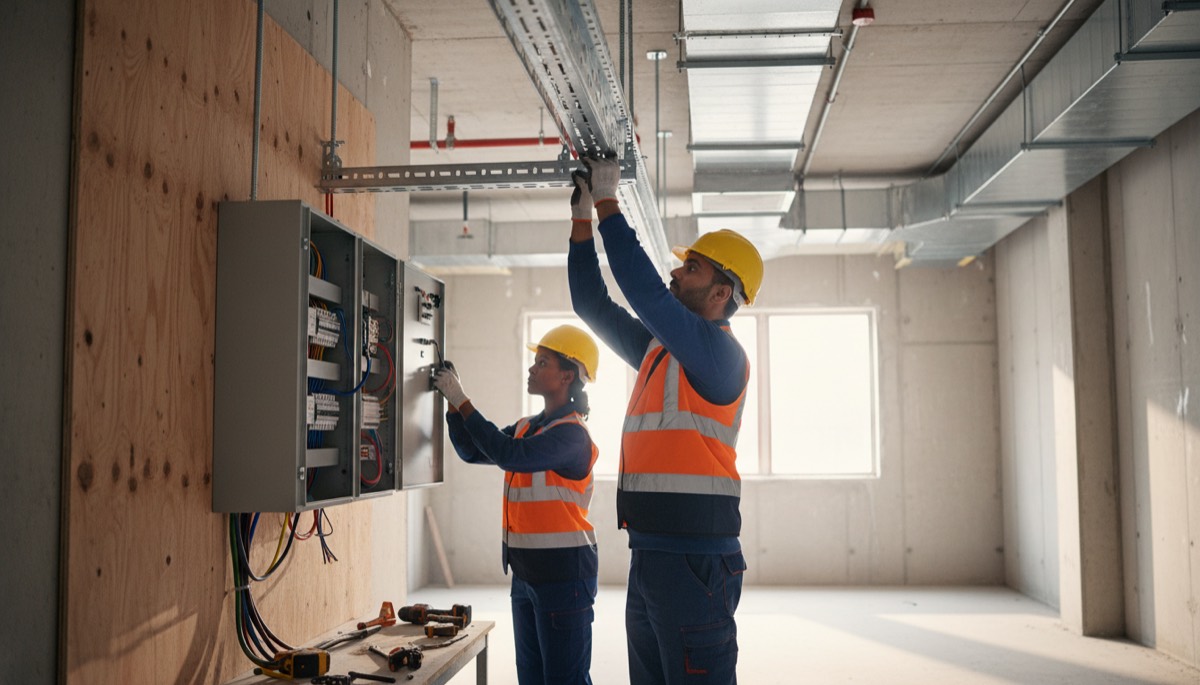
In the UK industry, "fully qualified" normally means someone who meets the requirements for the ECS Installation Electrician Gold Card. The JIB's 2026 handbook states that the mandatory requirement since 1999 has been the industry Level 3 apprenticeship standard or an approved JIB Level 3 competency-based qualification.
In practice, as we set out in our guide on how to become an electrician, that means:
- A Level 3 electrotechnical qualification: an apprenticeship standard or an NVQ.
- The AM2 assessment, the final practical test run by NET.
- The 18th Edition (BS 7671) qualification.
- The ECS Health, Safety and Environmental Assessment.
The difference from the domestic route is breadth. An installation electrician is trained and assessed across a wider range of premises and systems. That is why main contractors and commercial sites usually ask for the Gold Card, and why a card marked "Domestic Electrician" would not normally get you onto a commercial job.
What can each legally do? A job-by-job guide
The table below uses the rules for England. "Unregistered" means anyone who is not in a competent person scheme, however well qualified they are. In all cases the person doing the work must be competent and the work must meet BS 7671.
| Job in a home | Notifiable? | Registered domestic installer | Qualified electrician, not registered |
|---|---|---|---|
| Replace a socket, switch or light fitting | No | Yes, issue a certificate | Yes, issue a certificate |
| Add a socket or light to an existing circuit, outside a special location | No | Yes | Yes |
| Add to or alter a circuit in a bathroom | Yes | Yes, self-certifies | Yes, but needs third-party or building control sign-off |
| Install a new circuit, such as a cooker or EV charger | Yes | Yes, if in scope, self-certifies | Yes, but needs third-party or building control sign-off |
| Replace a consumer unit | Yes | Yes, self-certifies | Yes, but needs third-party or building control sign-off |
The scope of a registration matters here. If a business is registered for defined scope work only, its self-certification is limited to what that scope covers. Newer technologies are also tightening. The IET says that from October 2026, the EAS competence requirements extend to installers of EV charging equipment, solar PV, energy storage and micro wind turbines. Those installers now need the relevant category and qualifications, not just a general domestic registration.
For non-domestic premises, Part P does not apply at all, so scheme self-certification is irrelevant. The Electricity at Work Regulations and the requirement for competence still apply, and in practice the client or main contractor will set the bar, usually the ECS Gold Card.
What work is notifiable under Part P?
In England, under the 2013 edition of Approved Document P, the IET lists three types of notifiable work in a dwelling:
- installing a new circuit
- replacing a consumer unit
- adding to or altering an existing circuit in a special location
A special location is a room containing a bath or shower (defined by the zones around it) or a room containing a swimming pool or sauna heater.
Everything else counts as non-notifiable, including other additions and alterations outside special locations, and maintenance, replacement and repair. Non-notifiable work must still be safe and meet the regulations; it just does not have to be reported.
The rules are not the same across the UK.
- Wales: Welsh Building Regulations have diverged from England's since 2014, and the ECA notes the Welsh list of notifiable work is more extensive. Use the Welsh Approved Document P for work there.
- Scotland: Part P does not apply. Electrical Safety First says work under a building warrant must be approved by a registered installer acting as an approved certifier, or checked by the local authority.
- Northern Ireland: Electrical Safety First states there are currently no statutory requirements for domestic electrical installation work, though it still recommends using a registered electrician.
How does notifiable work get certified?
There are three routes for notifiable work in England.
- Self-certification. A business registered with a competent person scheme carries out the work and notifies it through the scheme. The IET lists five government-approved schemes: BESCA, Blue Flame Certification, NAPIT, OFTEC and Certsure, which trades as NICEIC and ELECSA.
- Registered third-party certifier. An unregistered installer arranges for a registered third party to inspect and test the work. The IET notes NAPIT as the only body currently authorised to operate third-party certification. Arrange this before work starts, not after.
- Building control. Approved Document P sets out building control notification as the fallback. Tell building control before the work begins, and expect to pay a fee.
Whichever route applies, the homeowner should end up with paperwork. Electrical Safety First says a registered electrician should provide an Electrical Installation Certificate or Minor Works Certificate confirming the work meets BS 7671, plus a Building Regulations Compliance Certificate confirming it meets the Building Regulations.
Who is better: a domestic installer or a qualified electrician?
For a homeowner, the two are not competing. The right question is whether the person can do this specific job, and certify it properly.
For work in a home, look for all of the following:
- Registration. Check the business on the scheme's own register, or on the Registered Competent Person Electrical register, and confirm the scope covers your job.
- Experience of that job. A rewire, an EV charger and a fuse board change are different jobs.
- Paperwork agreed up front. Confirm you will receive the right certificates.
A qualified electrician with no registration is not automatically wrong for the job, but on notifiable work you will need to know how it will be certified. A registered domestic installer is a sensible choice for most home work, but ask for the right scope if your job involves EV charging, solar or batteries.
Which route should you choose if you are starting out?
Your choice depends on what work you want in five years, not on which route seems quickest.
| If you want to | Consider | Watch out for |
|---|---|---|
| Keep every option open, including commercial and industrial | Installation Electrician apprenticeship or Level 3 NVQ, plus the AM2 | Needs access to varied site work |
| Work only in homes and run a small firm | Domestic Electrician apprenticeship in England | Your card will state "Domestic Electrician" |
| Formalise years of domestic experience | Domestic Electrician Experienced Worker Assessment | Needs three years' experience and a Level 2 qualification |
| Add electrical work to another trade | Check with a scheme whether defined scope (A1.4) fits you | Scope limits what you can certify |
If you work mainly in homes, the domestic route is a real qualification rather than a lesser one. Its limit is scope, not quality. If you might ever want commercial work, or to work for a large contractor, the wider route keeps that door open.
Whichever you choose, plan for more qualifications later. Inspection and testing qualifications are often the next step for anyone who wants to carry out EICRs or supervise work.
Frequently asked questions
Can a domestic installer work on commercial premises?
A domestic registration does not cover commercial premises, and a Domestic Electrician card is scoped to homes. There is no Part P rule stopping someone working elsewhere, but they must be competent for that work under the Electricity at Work Regulations, and most commercial clients will require an ECS Gold Card as an Installation or Maintenance Electrician.
Is a Part P electrician a qualified electrician?
Not necessarily. "Part P electrician" is an informal term for someone whose business is registered to self-certify work in dwellings. Their background may be a full apprenticeship, a domestic qualification or an older recognised route. Ask what qualifications they hold, and check the registration.
Can a qualified electrician sign off their own work without being registered?
They can issue a BS 7671 certificate for the electrical work, but they cannot self-certify notifiable work for Building Regulations purposes unless their business is registered with a competent person scheme. Otherwise, a registered third-party certifier or building control route is needed.
Can I do my own electrical work at home?
Legally you can, provided the work is safe and complies with Part P. Notifiable work must still go through a certification route, and that normally means arranging it before you start. Mistakes can cause fire or electric shock, so most homeowners are better using a registered electrician.
Do I need a Gold Card to join a competent person scheme?
The EAS does not ask for a card. It looks at the qualifications and experience of the Qualified Supervisor, and at the technical standard of the business's work. An ECS Gold Card holder will often meet the underpinning competence, but they still need the other requirements, including an initial verification qualification and two years' evidence of responsibility for technical standards.
Does Part P apply in Scotland?
No. Part P applies in England and Wales. Scotland has its own Building Standards system, in which an approved certifier can verify work carried out under a building warrant.
Who is responsible if electrical work in my home is not certified?
Electrical Safety First says homeowners and landlords must be able to prove that electrical work meets Part P. Uncertified notifiable work can also cause problems when you sell the property. Keep every certificate, and ask for them before making your final payment.
How Nexis Academy can help
Nexis Academy is a City & Guilds Approved Centre (T91185) in Manchester. We currently deliver internal wall insulation training, with more trade and construction courses in development. We do not yet offer electrical courses, so please register your interest to hear when that changes.
See also how to become an EV charger installer.
Sources
- HM Government, Approved Document P: Electrical safety (dwellings), 2013 edition.
- IET, Part P England and Wales: notifiable work, scheme operators, third-party certification, document editions.
- ECA, Part P FAQs: who can do work in dwellings, non-notifiable work, Welsh differences.
- IET, Electrotechnical Assessment Specification, June 2026 edition: work categories, Qualified Supervisor requirements, Appendix 4 competence tables.
- City & Guilds, Experienced Worker Assessment: Domestic Electrician and 5393 Level 3 Electrotechnical in Dwellings.
- TESP, How the Domestic Electrician Apprenticeship works: the facts, Professional Electrician, July 2022.
- JIB, Handbook 2026, Section 10: Electrotechnical Certification Scheme.
- Electricity at Work Regulations 1989, regulation 16.
- Electrical Safety First, Building Regulations: certificates, homeowner liability, Scotland and Northern Ireland.